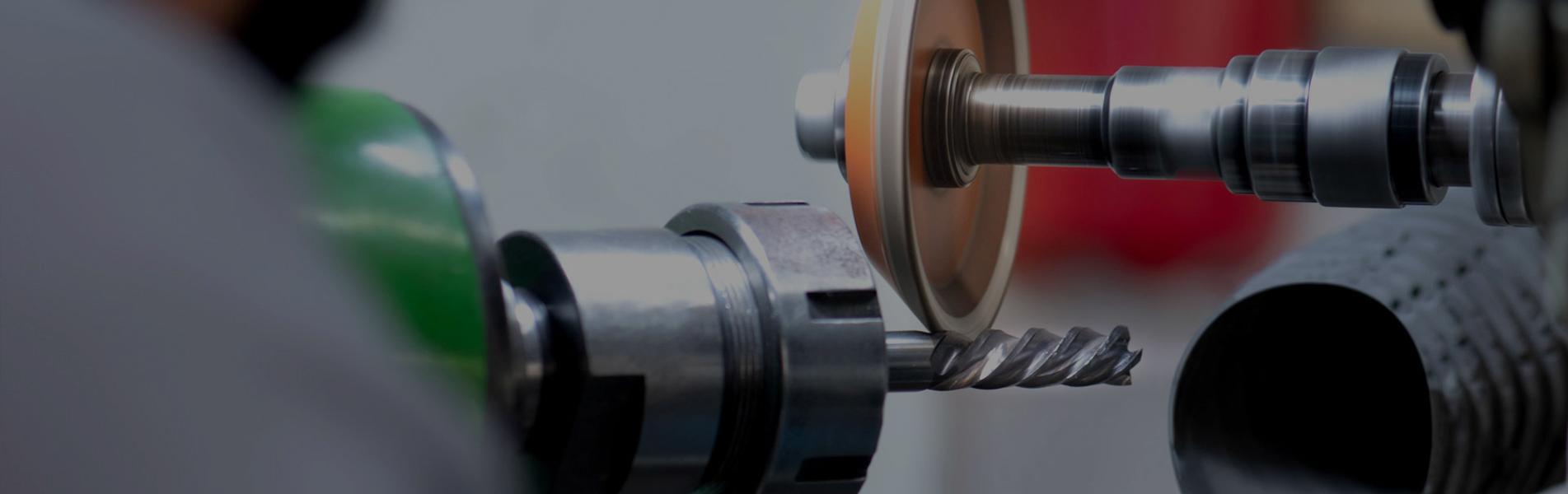
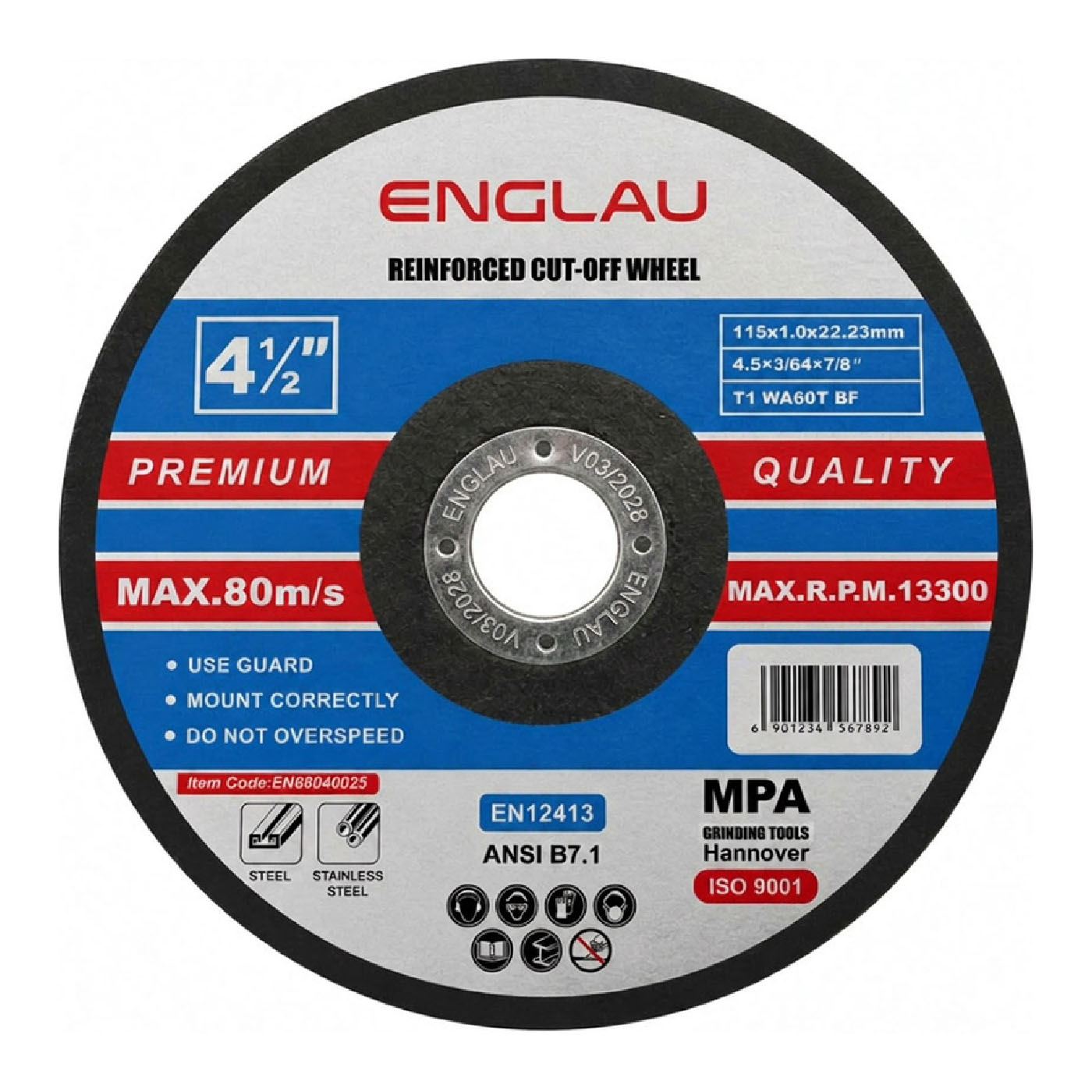
Our ceramic extra-thin cutting discs, powered by proprietary CERAMICS Plus grain technology, are the tool of choice for precise, fast cutting of metal components in automotive and aerospace manufacturing. Standard cutting discs and grinding wheels deliver reliable heavy-duty performance in structural steel fabrication, shipbuilding, and construction. Flap discs and fibre discs provide effective weld dressing and surface finishing in metalworking and equipment assembly, while non-woven abrasives and coated sanding belts are widely specified for stainless steel fabrication, furniture manufacturing, and construction material processing. Our wire brushes meet the requirements for rust removal, deburring, and weld cleaning across construction sites, maintenance workshops, and industrial facilities.
All Englau Group products are manufactured in strict accordance with the German EN 12413 standard, a globally recognised benchmark for abrasive tool safety and performance. Our application engineering team works directly with industrial customers to optimise grain formulations, define precise product specifications, and provide technical support to maximise operational efficiency and tool service life.
Industrial customers can access Englau Group’s technical support directly by contacting our application engineering team by phone or email. Our engineers will review your specific production requirements or surface treatment challenges and recommend tailored abrasive solutions and process optimisations. Follow-up consultations are available to validate performance outcomes and provide ongoing support as your production needs evolve.
Metal fabrication is the process of transforming raw metal stock into finished components, assemblies, and structures through a sequence of cutting, forming, and joining operations. It is a value-added process in the truest industrial sense — each stage of fabrication adds value. A typical fabrication project moves through three defined phases. The design phase establishes the engineering drawings, material specifications, and welding or joining procedures that the fabrication team will work to. The fabrication phase encompasses all cutting, forming, and joining operations that transform raw stock into finished components. The installation or assembly phase brings fabricated components together into the final structure or product, either in the workshop or on site.Abrasive tools specified for cutting, grinding, weld dressing, and surface finishing at each stage of fabrication directly affect dimensional accuracy, surface quality, throughput, and cost per part. Selecting the right abrasive for the right process — matched to the workpiece material and the required surface condition — is one of the most consequential decisions in a fabrication operation.
Jobs typically have three phases: design—where shop drawings match specifications; fabrication—which includes cutting, bending, and assembling; and installation, where the final product or structure is assembled.
Metal fabricators work with a broad range of raw material forms, including flat sheet and plate, structural sections (angle, channel, I-beam, hollow section), tube and pipe, bar stock, expanded metal, castings, and forgings. The choice of raw material form is determined by the geometry of the finished component, the required mechanical properties, and the fabrication processes available in the shop.
Fabrication operations range from small job shops handling bespoke one-off components to large-scale automated production facilities running high-volume programmes for the automotive, aerospace, and construction sectors. The workforce spans a range of trades — structural welders, coded pipe welders, boilermakers, sheet metal workers, press brake operators, and CNC machinists — each responsible for specific stages of the fabrication process.
Metal fabrication is broadly categorised into three types based on the end-use context and scale of the work: industrial, structural, and commercial fabrication. Each type presents distinct process requirements and abrasive tooling needs.
1. Industrial Metal Fabrication
Industrial metal fabrication encompasses the production of components and assemblies that form part of larger capital equipment and process plant. This includes pressure vessels, storage tanks, heat exchangers, conveyor systems, machine frames, processing plant structures, and heavy mechanical assemblies. Industrial fabrication typically involves thicker plate and heavier section material than commercial fabrication, and demands high structural integrity, precise dimensional tolerances, and in many cases compliance with pressure equipment directives or structural codes.
Industrial fabricators serve sectors including oil and gas, power generation, water treatment, chemical processing, aerospace, automotive manufacturing, and material handling. The scale of industrial fabrication work ranges from individual precision-machined components to complete assemblies. In industrial fabrication, abrasive cutting and surface treatment tools are used extensively throughout the production process — from initial plate cutting and edge preparation through to weld dressing, surface conditioning, and pre-inspection finishing. Englau Group’s CERAMICS Plus ceramic cutting discs, grinding wheels, and flap discs are widely used in industrial fabrication environments for their combination of cutting speed, surface quality, and extended tool life. In the next section, industrial metal parts are typically used in complementary pairs.
2. Structural Metal Fabrication
Structural metal fabrication involves the production of load-bearing components for construction and civil engineering projects. These components form the primary framework of buildings, bridges, industrial structures, and infrastructure, and must meet strict structural engineering specifications governing material grade, dimensional accuracy, weld quality, and surface treatment.
Structural steel is the dominant material in this category, valued for its high strength-to-weight ratio, weldability, and availability in a wide range of standard section profiles. Grade S275 and S355 structural steels are the most widely specified in building and bridge construction, while higher-strength grades are used in long-span structures and heavy industrial applications.
Structural steel fabrication involves significant abrasive work at multiple stages: flame or plasma cut edges require grinding to remove the heat-affected zone and achieve the required edge quality; weld preparations must be ground to the correct profile before welding; and completed welds require dressing to meet inspection and coating requirements. Englau Group’s zirconia alumina and ceramic flap discs are widely used in structural steel fabrication for weld dressing and edge preparation, providing consistent stock removal with a controlled surface finish.
Typical structural fabrication components include:
- Towers and masts — custom-fabricated structural elements for industrial facilities, telecommunications, and power transmission
- Platforms and mezzanines — used as loading bays, storage decks, access platforms, and facility ramps in industrial and logistics environments
- Industrial walkways and grating — fabricated to meet applicable safety standards for access and egress in industrial facilities.
- Stairs are necessary for durability and strength in various settings.
- Primary structural members — trusses, girders, beams, columns, and connection plates that form the load-bearing framework of buildings. Commercial metal fabrication produces components and fittings for installation in commercial, retail, hospitality, and public sector environments. This category typically involves lighter-gauge sheet metal, tighter surface finish requirements, and a higher degree of decorative or architectural intent than sinks, benches, and catering equipment — fabricated from 304 or 316 stainless steel for food service, healthcare, and laboratory environments. Typical commercial fabrication products include:ilGuardrails and balustrades — fabricated in mild steel, stainless steel, or aluminium for safety and architectural applications. Commercial metal products may include the following:
- Guardrails
- Awnings and canopies — structural metal frameworks for weather protection on commercial and public buildings
- Shelving and racking systems — fabricated in mild steel or stainless steel for retail, storage, and food service environments
- Sinks and other appliances
- Conveyor systems and material handling equipment — fabricated in mild steel or stainless steel for food processing, logistics, and manufacturing environments
Ornamental and architectural metalwork is a further category within commercial fabrication, encompassing decorative facades, cladding panels, feature staircases, and bespoke fittings designed to meet both structural and aesthetic requirements. Surface finish quality is particularly important in this segment — non-woven surface conditioning discs and fine-grade coated abrasives are widely used to achieve the consistent brushed or polished finishes specified for stainless steel and aluminium architectural elements.
Compared to structural and industrial metal parts, commercial parts tend to be smaller and more precise. However, they’re just as important to how a commercial entity operates, both from a functional standpoint and in keeping employees and customers safe.
4. Selecting the Right Abrasive for Metal Fabrication
Across all three categories of metal fabrication — industrial, structural, and commercial — abrasive tools are required at every stage of the production process. Selecting the correct product for each operation is one of the most consequential decisions a production manager or procurement buyer can make. The wrong specification leads to excessive heat generation, poor surface finish, premature disc failure, and increased per-part cost. The right specification delivers consistent results, reduced downtime, and a lower total cost of ownership.
For cutting carbon steel and stainless steel, Englau Group recommends our CERAMICS Plus ceramic cutting discs. Powered by a proprietary self-sharpening microcrystalline ceramic-alumina grain, these discs deliver up to 50% faster cutting speeds and up to 600% longer service life compared to conventional aluminium oxide discs — reducing disc change frequency and cost per cut across high-volume fabrication operations. Available in thicknesses from 1.0 mm and diameters up to 400 mm, CERAMICS Plus discs are compatible with angle grinders, bench-mounted drop saws, and air tools.
For heavy stock removal, weld dressing, and edge preparation on structural and industrial steel, our zirconia-alumina flap discs deliver aggressive, consistent performance on ferrous metals. Ceramic alumina flap discs are the preferred choice for stainless steel weld dressing, where controlled heat input and surface quality are critical. For surface conditioning of stainless steel and aluminium architectural and commercial components, our non-woven abrasive discs deliver a uniform finish without thermal discolouration or the risk of over-grinding.
For rust removal, weld cleaning, and pre-paint surface preparation, our steel wire brushes — available in twist-knot and crimped configurations — provide reliable mechanical cleaning across all surface conditions. Where ferrous contamination or spark generation must be avoided, our brass wire brushes are the specified solution.
All Englau Group products are manufactured to EN 12413 and are supported by our application engineering team, which is available to review your specific production requirements and recommend the optimal abrasive specification for each stage of your fabrication process.
Frequently Asked Questions: Metal Fabrication
What abrasive tools does Englau Group recommend for industrial metal fabrication?
Englau Group offers a complete range of abrasive solutions covering every stage of the metal fabrication process. For cutting, our CERAMICS Plus ceramic cutting discs deliver up to 50% faster cutting speeds and up to 600% longer service life than conventional aluminium oxide discs on carbon steel and stainless steel. For grinding and weld dressing, our ceramic and zirconia alumina flap discs provide consistent stock removal on ferrous metals. For surface conditioning and finishing, our non-woven abrasive discs and coated sanding belts cover applications from heavy scale removal to fine pre-coat finishing. For mechanical surface cleaning, our steel and brass wire brushes handle rust removal, weld cleaning, and pre-paint preparation across all surface conditions.
What are the three types of metal fabrication?
The three principal categories of metal fabrication are industrial, structural, and commercial. Industrial fabrication produces components for capital equipment and process plant — including pressure vessels, tanks, and machine frames. Structural fabrication produces load-bearing components for construction and civil engineering — including beams, columns, trusses, and connection plates. Commercial fabrication produces components for retail, hospitality, and public sector environments — including catering equipment, guardrails, shelving, and architectural metalwork. Each category has distinct process requirements and abrasive tooling needs.
At what stages of the fabrication process are abrasive tools required?
Abrasive tools are used at multiple stages of the fabrication process. At the cutting stage, abrasive cutting discs are used to reduce raw stock to blank dimensions. At the edge preparation stage, grinding wheels and flap discs are used to dress cut edges and prepare weld joints. At the welding stage, flap discs and fibre discs are used to dress completed welds and remove heat-affected zones. At the surface finishing stage, non-woven conditioning discs, coated sanding belts, and wire brushes are used to achieve the required surface condition for coating, inspection, or end use. Englau Group supplies abrasive solutions for all of these stages.
Does Englau Group supply abrasives for both ferrous and non-ferrous metals?
Yes. Englau Group supplies abrasive solutions for the full range of ferrous and non-ferrous metals encountered in industrial fabrication. Our product range covers carbon steel, stainless steel, aluminium alloys, copper alloys, brass, titanium, and nickel superalloys. We offer ceramic alumina, zirconia alumina, aluminium oxide, silicon carbide, and CBN grain types to match the specific cutting and grinding requirements of each material. All products are manufactured to EN 12413 standard. Our application engineering team is available to review your material and process requirements and recommend the optimal product specification.
What certifications do Englau Group abrasive products carry?
All Englau Group abrasive products are manufactured in strict accordance with the German EN 12413 standard — one of the most stringent quality and safety certifications in the global abrasives industry. EN 12413 governs the structural integrity, operational safety, and performance consistency of bonded abrasive tools, and is widely recognised by industrial procurement teams as the benchmark standard for abrasive product qualification. Our products are suitable for use in regulated industrial environments including aerospace, oil and gas, and pressure equipment fabrication.
Does Englau Group offer application-specific or custom formulations?
Yes. With over 20 years of experience, we develop market-specific, application-optimised formulations tailored to customers’ unique usage conditions and performance requirements. To request a custom formulation, buyers are invited to contact our technical team with details of their intended application, material type, and specific performance goals. Our workflow includes initial technical consultation, proposed specification and sample development, and performance validation on the customer's production line. Upon customer approval, full-scale production begins. The typical timeline for this process is 2–3 weeks for initial formulation and sample delivery, with overall lead times varying based on the complexity of the requirements. Our team keeps you informed at each step to ensure a transparent and efficient experience.
Do you accept OEM orders and private label manufacturing?
Yes. Englau Group supports full OEM manufacturing and can produce our complete range of abrasive products under your brand, with custom labelling, packaging design, and product specifications customised to your market requirements. The minimum order quantity is 1,000 pieces per item. Our typical OEM process includes an initial requirements discussion, confirmation of artwork and product specifications, sample production and approval, and bulk manufacturing and shipment. The lead time is usually 2–3 weeks for sample development after requirements are finalised, and 4–6 weeks for bulk production after sample approval. Timelines may vary depending on order complexity and customisation needs, so we encourage customers to share their specific project requirements for accurate scheduling.
For technical inquiries, product specifications, sample requests, or OEM discussions, please contact Englau Group directly:
Mr. Eric Lau
President, Englau Group Co., Limited
Room 1205, 12/F, 130-132 Des Voeux Road Central, Hong Kong
Phone: +86 137 7034 5768
Email: eric.twintrade@gmail.com