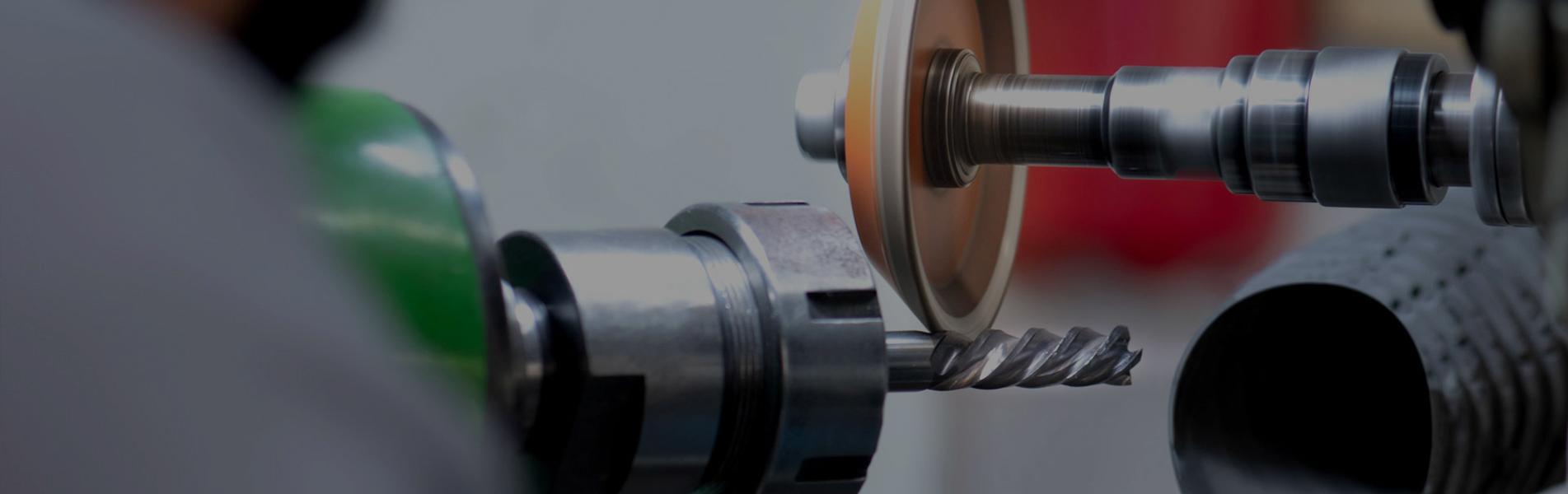
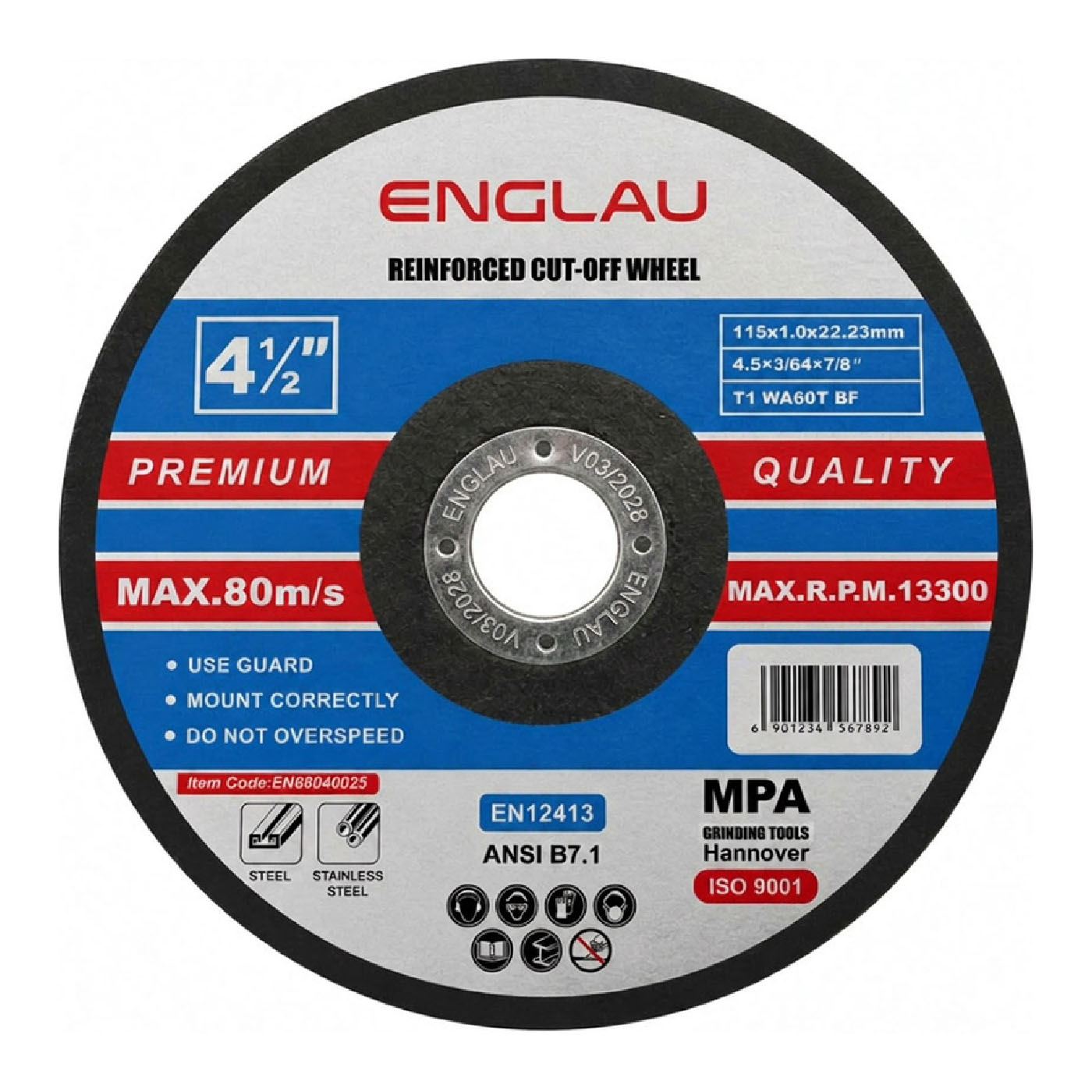
With over 20 years of expertise in the abrasives and industrial tooling industry, Englau Group designs, manufactures, and exports a comprehensive range of high-performance surface treatment solutions to industrial customers worldwide. Our core product range spans ceramic extra-thin cutting discs, standard cutting discs, grinding wheels, flap discs, fibre discs, non-woven abrasives, coated sanding belts, and wire brushes — each engineered to deliver consistent performance, extended tool life, and measurable productivity gains across the most demanding industrial applications.
Our ceramic extra-thin cutting discs, powered by proprietary CERAMICS Plus grain technology, are the tool of choice for precise, fast cutting of metal components in automotive and aerospace manufacturing. Standard cutting discs and grinding wheels deliver reliable heavy-duty performance in structural steel fabrication, shipbuilding, and construction. Flap discs and fibre discs provide effective weld dressing and surface finishing in metalworking and equipment assembly, while non-woven abrasives and coated sanding belts are widely specified for stainless steel fabrication, furniture manufacturing, and construction material processing. Our wire brushes meet the requirements for rust removal, deburring, and weld cleaning across construction sites, maintenance workshops, and industrial facilities.
All Englau Group products are manufactured in strict accordance with the German EN 12413 standard, a globally recognized benchmark for abrasive tool safety and performance. Our application engineering team works directly with industrial customers to optimise grain formulations, define precise product specifications, and provide technical support to maximise operational efficiency and tool service life.
Industrial customers can access Englau Group’s technical support directly by contacting our application engineering team by phone or email. Our engineers will review your specific production requirements or surface treatment challenges and recommend tailored abrasive solutions and process optimisations. Follow-up consultations are available to validate performance outcomes and provide ongoing support as your production needs evolve.
Metal fabrication is the process of transforming raw metal stock into finished components, assemblies, and structures through a controlled sequence of cutting, forming, and joining operations. It is a value-added process in the truest industrial sense — each stage adds precision, geometry, and function to material that would otherwise serve no practical purpose in its raw state.
For production engineers and procurement buyers, understanding the metal fabrication process is directly relevant to abrasive product selection. The cutting discs, grinding wheels, flap discs, and surface conditioning tools specified at each stage of fabrication determine dimensional accuracy, surface quality, throughput, and cost per part. Getting the specification right — matched to the workpiece material, the process, and the required surface condition — is one of the most consequential decisions in any fabrication operation. At Englau Group, we have supported industrial fabricators across more than 20 years of production, and we bring that experience to every product recommendation we make.
A typical fabrication project moves through three defined phases. In the design phase, engineering drawings, material specifications, and welding or joining procedures are established. In the fabrication phase, cutting, forming, and joining operations transform raw stock into finished components. In the installation or assembly phase, fabricated components are brought together into the final structure or product, either in the workshop or on site. Large fabrication shops employ a broad range of value-added processes — including cutting, forming, welding, machining, and surface treatment — and may handle projects from a single bespoke component through to complete structural assemblies.
Fabrication operations range from manual job shop work to fully automated production lines serving the automotive, aerospace, and construction sectors. While processes such as machining, forging, stamping, and casting may produce similar component geometries, they are technically distinct from fabrication — which is defined by the assembly of finished components from raw stock through cutting, forming, and joining.
1. Core Fabrication Processes
• Cutting is done by sawing, shearing, or chiseling (all with manual and powered variants); torching with handheld torches (such as oxy-fuel torches or plasma torches); and via numerical control (CNC) cutters (using a laser, mill bits, torch, or water jet).
Bending applies a controlled force to the metal to produce a permanent angular or curved deformation without removing material. The principal methods used in fabrication include press brake forming, roll forming, and rotary draw bending. Press brake forming — using a punch and die with CNC-controlled backgauges for precise bend-line placement — is the most widely used method for sheet and plate, capable of producing accurate bend angles across a broad range of material thicknesses. Roll forming is preferred for producing continuous curved profiles, while rotary draw bending is used for tube and pipe.
Prior to bending, surface scale, weld spatter, and mill finish should be removed using a flap disc or surface conditioning disc to prevent surface cracking or delamination at the bend zone. Englau Group’s ceramic alumina and zirconia alumina flap discs are well-suited to this pre-forming surface preparation, delivering consistent stock removal with a controlled finish.
Assembly and joining brings cut and formed components together into the finished structure or product. Welding is the primary joining method in metal fabrication, fusing two workpieces by melting the base material and introducing a filler metal to form a continuous, high-strength joint. Common welding. Fabrication Disciplines and Specialisations
Metal fabrication overlaps with a range of related metalworking disciplines, each contributing specific capabilities to the broader fabrication process:ch suited to different material thicknesses, joint configurations, and production environments. Additional joining methods include brazing, soldering, riveting, bolting, and adhesive bonding, each suited to specific material combinations and service requirements.
Fabrication comprises or overlaps with various metalworking specialities:
Fabrication shops and machine shops share some capabilities but serve distinct functions. Fabrication shops concentrate on metal preparation and assembly — cutting, forming, and joining raw stock into finished components and structures. Machine shops focus on precision material removal using lathes, mills, and CNC machining centres to produce close-tolerance parts. Many industrial facilities combine both capabilities under one roof.
Blacksmithing is one of the oldest forms of metal fabrication, using heat and mechanical force to shape ferrous metals. Modern industrial forging operations are the direct descendant of traditional blacksmithing.
Welding and weldment production is a core fabrication discipline. A weldment is any assembly produced by welding, ranging from simple brackets and frames to complex pressure vessels and structural assemblies. Post-weld surface treatment — including weld dressing, spatter removal, and heat-affected zone grinding — is an essential step in weldment production before inspection, coating, or installation.
Boilermaking encompasses the fabrication and maintenance of pressure vessels, boilers, tanks, and heat exchangers. It is a highly regulated discipline, with fabrication work required to comply with applicable pressure equipment directives and welding procedure standards.
Millwrights specialise in the installation, maintenance, and fabrication of industrial machinery and mechanical systems. Their work encompasses precision alignment, shaft fitting, bearing installation, and the fabrication of custom components and supports for plant and process equipment.
Ironworkers and steel erectors are responsible for the on-site assembly and erection of structural steelwork. They work with prefabricated sections produced in fabrication shops. Metal fabrication operations draw on a wide range of raw material forms. The choice of material form is determined by the geometry of the finished component, the required mechanical properties, and the fabrication processes available. Standard raw material forms used in fabrication include: single bolted connections, welding, or a combination of both. Site abrasive work — including bolt hole preparation, weld dressing, and surface treatment prior to site painting — is a routine part of ironwork operations.
Raw materials
Standard metal fabrication materials are:
Flat sheet and plate — the most widely used form in structural, commercial, and industrial fabrication, available in a range of grades and thicknesses from thin gauge sheet to heavy structural plate
Formed and expanded metal — including structural, I-beam, hollow section-, expanded mesh, and perforated sheet- used in structural frameworks, grating, and architectural applications
Tube and pipe — circular, square, and rectangular hollow sections used in structural frames, pressure systems, and mechanical assemblies
• Welding wire/welding rod
Castings and forgings — near-net-shape components produced by pouring molten metal into a mould or by compressive forming, used where complex geometry or high mechanical integrity is required and machining from solid would be impractical
4. Cutting and Burning Methods
A range of cutting methods are used in fabrication depending on the material, section size, required edge quality, and available equipment. Shearing is the most common method for flat sheet and plate, using opposing blades to produce a clean separation without heat generation. For structural sections, bar, and tube, band sawing and cold sawing are widely used. For complex profiles and high-precision cutting, laser and plasma cutting are preferred. For versatility and portability across all fabrication environments, abrasive disc cutting remains the most widely deployed method.
Band saws for metal cutting use hardened bi-metal or carbide-tipped blades with controlled feed mechanisms to produce accurate, burr-free cuts on structural sections and bar stock. Abrasive cut-off saws — bench-mounted drop saws fitted with bonded abrasive cutting discs — are widely used for cutting steel tube, pipe, and sections to length. The performance of a cut-off saw is directly determined by the quality of the abrasive disc: Englau Group’s CERAMICS Plus ceramic cutting discs, with their self-sharpening microcrystalline grain structure, maintain consistent cutting speed and edge quality throughout the disc’s life, significantly outperforming conventional aluminium oxide discs in both speed and longevity. Oxy-fuel and plasma torches are used for cutting heavy plate and structural sections where mechanical cutting methods are impractical.
CNC burn tables use computer-controlled cutting heads — powered by a natural gas flame, plasma arc, or laser — to cut complex profiles from flat plates at high speed and with high repeatability. Waterjet cutting tables use high-pressure water and abrasive slurry to cut material without heat generation, making them suitable for heat-sensitive materials and precision profiles. Higher-specification CNC tables incorporate punch-and-tap capability for combined cutting and hole-forming operations in a single setup. In structural steel fabrication, robotic plasma and laser cutting systems move the cutting head in three dimensions around the workpiece, enabling the automated cutting of complex joint preparations and coping profiles on structural sections.
Regardless of the cutting method used, cut edges on structural steel, stainless steel, and non-ferrous metals typically require post-cut abrasive dressing to remove the heat-affected zone, slag, or burr before downstream processing. Englau Group’s grinding wheels and flap discs are the standard tools for this operation, providing fast, controlled edge preparation across all material types.
5. Forming
Forming converts flat sheet metal and plate into three-dimensional components by applying force to produce a permanent change in shape — without adding or removing material. The force must exceed the material's yield strength to produce plastic deformation, and is controlled through tooling such as punches, dies, and roll sets. The principal forming processes used in industrial fabrication include press brake bending, roll forming, stamping, deep drawing, and hydroforming.
Press brake bending is the most widely used forming process for sheet and plate, producing precise angular bends using a punch and die set with CNC-controlled backgauges. Roll forming produces continuous curved profiles by passing the workpiece through a series of progressively shaped rolls. Stamping uses a die set in a press to produce complex three-dimensional forms from sheet metal in a single stroke — the dominant forming process in high-volume automotive and appliance manufacturing. Most metallic materials, being ductile and capable of significant permanent deformation, lend themselves well to these forming techniques.
Properly designed tooling and machinery produce highly repeatable formed components, making forming processes well suited to medium and high-volume production programmes across aerospace, automotive, construction, and industrial equipment manufacturing. Prior to forming, surface preparation using a flap disc or surface conditioning disc removes scale, spatter, and contamination that could cause cracking or delamination at the bend zone — a step that Englau Group’s ceramic and zirconia alumina flap discs handle efficiently across all steel and aluminium grades.
6. Machining
Machining is a precision material-removal process that uses cutting tools to produce components with close dimensional tolerances and fine surface finishes from metal stock or near-net-shape blanks. Fabrication shops typically maintain machining capability — including metal lathes, vertical and horizontal milling machines, drill presses, and CNC machining centres — to produce the solid machined components that form part of larger fabricated assemblies. Gears, shafts, bolts, flanges, and bearing housings are among the most common machined components produced in a fabrication environment.
Abrasive grinding is an integral part of precision machining, used for final-dimension grinding, surface grinding, and cylindrical grinding when the tolerances required exceed the capabilities of conventional cutting tools. Englau Group’s CBN (Cubic Boron Nitride) grinding wheels are the preferred solution for precision grinding of hardened steels and superalloys, offering the hardness and thermal stability required to maintain consistent material removal and surface finish without wheel glazing.
7. Welding and Post-Weld Treatment
Welding is central to metal fabrication, providing the primary means of permanently joining formed and machined components into finished assemblies. Parts are typically assembled and tack-welded first to verify dimensional accuracy and alignment before full welding proceeds. In complex multi-part weldments, precision fixtures are used to locate and hold components in the correct position, ensuring that weld distortion does not compromise the finished geometry. Welders work to engineering drawings and approved welding procedure specifications, and in regulated industries — including pressure equipment, structural steel, and aerospace fabrication — welders must hold current procedure qualifications.
Weld distortion is a significant concern in fabrication, particularly for thin-walled structures, long weldments, and assemblies with complex joint sequences. Distortion control measures include joint redesign to minimise weld volume, balanced and staggered welding sequences, use of back-step welding, pre-setting components at an offset angle to allow for anticipated distortion, and the use of restraint fixtures during welding and cooling.
Where distortion has occurred, post-weld straightening may be carried out using controlled flame heating with an oxy-acetylene torch. Heat is applied in a slow, linear sweep, causing the steel to contract in the direction of the sweep as it cools. This technique requires considerable skill and experience to achieve the desired correction without introducing additional stress or distortion.
Where residual welding stresses are a concern — particularly in precision machined assemblies, pressure vessels, and engine components — weldments may be stress-relieved by controlled heating in a low-temperature oven. Post-heat-treatment machining, including line boring of bearing housings and cylinder bores, restores dimensional accuracy after any thermally induced movement.
After cooling, weld seams are dressed using grinding wheels or flap discs to remove excess weld bead, spatter, and heat-affected zone material, achieving the surface condition required for inspection and downstream processing. The assembly is then surface-treated — typically by abrasive blasting, chemical cleaning, priming, and painting — before final inspection and despatch.
Englau Group’s ceramic flap discs are the preferred tool for weld dressing on both carbon steel and stainless steel, maintaining consistent stock removal throughout the disc’s life while providing the flexibility to follow weld profiles and contoured surfaces. Our steel wire brushes are used for spatter removal and pre-paint surface cleaning, while our non-woven surface conditioning discs deliver the controlled, uniform finish required before painting or coating on stainless steel and aluminium components.
8. Speciality Processes in Metal Fabrication
Many fabrication shops offer speciality proPowder coating — an electrostatic dry finishing process that produces a durable, corrosion-resistant surface coating on fabricated steel and aluminium components, widely used as an alternative to wet paint in industrial and architectural applicationsPrecision machining — CNC turning, milling, grinding, and boring operations that produce close-tolerance components and finished surfaces beyond the capability of conventional fabrication toolingg — the production of near-net-shape components by pouring molten metal into a mould, used for complex geometries that would be impractical to fabricate from wrought stock.
• Powder coating
Powder metallurgy — a net-shape manufacturing process that produces components by compressing and sintering metal powder, used for high-volume production of complex parts with controlled porosity or composition
Specialist welding — including coded pipe welding, TIG welding of stainless steel and aluminium, and robotic welding for high-volume production programmes requiring consistent weld quality and throughput
• Machining
9. Englau Group Abrasive Solutions for Metal Fabrication
Across every stage of the metal fabrication process — from initial cutting and edge preparation through to weld dressing, surface conditioning, and pre-coat finishing — the abrasive tools specified have a direct and measurable impact on production efficiency, surface quality, and cost per part.
Englau Group has been manufacturing and exporting high-performance abrasive solutions for over 20 years, and our product range covers every abrasive requirement in the fabrication workflow. As one of the earliest developers of ceramic cutting disc technology in China, our CERAMICS Plus ceramic cutting discs represent the current benchmark in abrasive cutting performance — delivering up to 50% faster cutting speeds and up to 600% longer service life compared to conventional aluminium oxide discs. The self-sharpening microcrystalline grain structure continuously exposes fresh cutting edges as the disc wears, maintaining consistent speed and cut quality from the first cut to the last.
For weld dressing and stock removal on structural and industrial steel, our zirconia-alumina flap discs deliver aggressive, consistent performance on ferrous metals. Our ceramic alumina flap discs are the preferred choice for weld dressing on stainless steel, where controlled heat input and surface quality are critical. For surface conditioning on stainless steel, aluminium, and architectural metalwork, our non-woven abrasive discs deliver a uniform finish without thermal discolouration. For rust removal, spatter cleaning, and pre-paint surface preparation, our steel wire brushes — available in twist-knot and crimped configurations — provide reliable mechanical cleaning across all surface conditions. Where ferrous contamination or spark generation must be avoided, our brass wire brushes are the specified solution.
All Englau Group products are manufactured to the EN 12413 standard and are compatible with standard angle grinders, bench-mounted drop saws, and air tools. We accept OEM manufacturing orders with a minimum quantity of 1,000 pieces per item, and our application engineering team is available to review your specific production requirements and recommend the optimal abrasive specification for each stage of your fabrication process.
Frequently Asked Questions: Metal Fabrication
What abrasive tools does Englau Group recommend for industrial metal fabrication?
Englau Group offers a complete range of abrasive solutions covering every stage of the metal fabrication process. For cutting, our CERAMICS Plus ceramic cutting discs deliver up to 50% faster cutting speeds and up to 600% longer service life than conventional aluminium oxide discs on carbon steel and stainless steel. For grinding and weld dressing, our ceramic and zirconia alumina flap discs provide consistent stock removal on ferrous metals. For surface conditioning and finishing, our non-woven abrasive discs and coated sanding belts cover applications from heavy scale removal to fine pre-coat finishing. For mechanical surface cleaning, our steel and brass wire brushes remove rust, clean welds, and prepare surfaces for paint across all surface conditions.
What are the three types of metal fabrication?
The three principal categories of metal fabrication are industrial, structural, and commercial. Industrial fabrication produces components for capital equipment and process plant — including pressure vessels, tanks, and machine frames. Structural fabrication produces load-bearing components for construction and civil engineering — including beams, columns, trusses, and connection plates. Commercial fabrication produces components for retail, hospitality, and public sector environments — including catering equipment, guardrails, shelving, and architectural metalwork. Each category has distinct process requirements and abrasive tooling needs.
At what stages of the fabrication process are abrasive tools required?
Abrasive tools are used at multiple stages of the fabrication process. At the cutting stage, abrasive cutting discs are used to reduce raw stock to blank dimensions. At the edge preparation stage, grinding wheels and flap discs are used to dress cut edges and prepare weld joints. At the welding stage, flap discs and fibre discs are used to dress completed welds and remove heat-affected zones. At the surface-finishing stage, nonwoven conditioning discs, coated sanding belts, and wire brushes are used to achieve the required surface condition for coating, inspection, or end use. Englau Group supplies abrasive solutions for all of these stages.
Does Englau Group supply abrasives for both ferrous and non-ferrous metals?
Yes. Englau Group supplies abrasive solutions for the full range of ferrous and non-ferrous metals encountered in industrial fabrication. Our product range covers carbon steel, stainless steel, aluminium alloys, copper alloys, brass, titanium, and nickel superalloys. We offer ceramic alumina, zirconia alumina, aluminium oxide, silicon carbide, and CBN grain types to match the specific cutting and grinding requirements of each material. All products are manufactured to EN 12413 standard. Our application engineering team is available to review your material and process requirements and recommend the optimal product specification.
What certifications do Englau Group abrasive products carry?
All Englau Group abrasive products are manufactured in strict accordance with the German EN 12413 standard — one of the most stringent quality and safety certifications in the global abrasives industry. EN 12413 governs the structural integrity, operational safety, and performance consistency of bonded abrasive tools, and is widely recognised by industrial procurement teams as the benchmark standard for abrasive product qualification. Our products are suitable for use in regulated industrial environments, including aerospace, oil and gas, and pressure equipment fabrication.
Does Englau Group offer application-specific or custom formulations?
Yes. With over 20 years of experience, we develop market-specific, application-optimised formulations tailored to customers’ unique usage conditions and performance requirements. To request a custom formulation, buyers are invited to contact our technical team with details of their intended application, material type, and specific performance goals. Our workflow includes initial technical consultation, proposed specification and sample development, and performance validation on the customer's production line. Upon customer approval, full-scale production begins. The typical timeline for this process is 2–3 weeks for initial formulation and sample delivery, with overall lead times varying based on the complexity of the requirements. Our team keeps you informed at each step to ensure a transparent and efficient experience.
Do you accept OEM orders and private label manufacturing?
Yes. Englau Group supports full OEM manufacturing and can produce our complete range of abrasive products under your brand, with custom labelling, packaging design, and product specifications customised to your market requirements. The minimum order quantity is 1,000 pieces per item. Our typical OEM process includes an initial requirements discussion, confirmation of artwork and product specifications, sample production and approval, and bulk manufacturing and shipment. The lead time is usually 2–3 weeks for sample development after requirements are finalised, and 4–6 weeks for bulk production after sample approval. Timelines may vary depending on order complexity and customisation needs, so we encourage customers to share their specific project requirements for accurate scheduling.
For technical inquiries, product specifications, sample requests, or OEM discussions, please contact Englau Group directly:
Mr. Eric Lau
President, Englau Group Co., Limited
Room 1205, 12/F, 130-132 Des Voeux Road Central, Hong Kong
Phone: +86 137 7034 5768
Email: eric.twintrade@gmail.com