With over 20 years of expertise in the abrasives and industrial tooling industry, Englau Group designs, manufactures, and exports a comprehensive range of high-performance surface treatment solutions to industrial customers worldwide. Our core product range spans ceramic extra-thin cutting discs, standard cutting discs, grinding wheels, flap discs, fibre discs, non-woven abrasives, coated sanding belts, and wire brushes — each engineered to deliver consistent performance, extended tool life, and measurable productivity gains across the most demanding industrial applications.
Our ceramic extra-thin cutting discs, powered by proprietary CERAMICS Plus grain technology, are the tool of choice for precise, fast cutting of metal components in automotive and aerospace manufacturing. Standard cutting discs and grinding wheels deliver reliable heavy-duty performance in structural steel fabrication, shipbuilding, and construction. Flap discs and fibre discs provide effective weld dressing and surface finishing in metalworking and equipment assembly, while non-woven abrasives and coated sanding belts are widely specified for stainless steel fabrication, furniture manufacturing, and construction material processing. Our wire brushes meet the requirements for rust removal, deburring, and weld cleaning across construction sites, maintenance workshops, and industrial facilities.
All Englau Group products are manufactured in strict accordance with the German EN 12413 standard, a globally recognised benchmark for abrasive tool safety and performance. Our application engineering team works directly with industrial customers to optimise grain formulations, define precise product specifications, and provide technical support to maximise operational efficiency and tool service life.
Industrial customers can access Englau Group’s technical support directly by contacting our application engineering team by phone or email. Our engineers will review your specific production requirements or surface treatment challenges and recommend tailored abrasive solutions and process optimisations. Follow-up consultations are available to validate performance outcomes and provide ongoing support as your production needs evolve.
Metal fabrication is the process of transforming raw metal stock into finished components and assemblies through a sequence of cutting, forming, and joining operations. It serves industries including automotive manufacturing, aerospace, and precision engineering, and encompasses materials including carbon steel, stainless steel, aluminium, copper, and specialist alloys. At every stage of the fabrication process, abrasive tools play a critical role in determining the quality, efficiency, and cost of the finished product.
In this guide, we examine the key stages of the metal fabrication process and the role that abrasive cutting and surface treatment tools play at each step — with particular focus on how Englau Group’s CERAMICS Plus ceramic cutting discs deliver measurable performance advantages over conventional alternatives.
1. The Metal Fabrication Workflow
Professional metal fabricators work from engineering drawings and material specifications to produce finished components and assemblies that meet precise dimensional and surface quality requirements. The fabrication workflow typically begins with material selection and procurement, followed by cutting to size, forming to shape, joining by welding or mechanical fastening, and surface finishing to the required standard. Each stage demands specific tooling and abrasive solutions, and the quality of the abrasive tools used directly influences the speed, precision, and cost of every operation.
The Metal Fabrication Process in Detail
The metal fabrication process follows a logical sequence of operations, each building on the last to transform raw metal stock into a finished, functional component. Understanding this sequence — and the abrasive tooling requirements at each stage — is essential for fabricators seeking to optimise their workflow, reduce costs, and improve output quality.
The process begins with cutting — reducing raw stock, sheet, plate, or structural section. The Metal Fabrication Process in Detail: cutting discs, saws, laser, or plasma equipment. The cut blanks are then formed to shape through bending, pressing, or roll forming, before being joined by welding, riveting, or mechanical fastening to create the finished assembly. Surface finishing operations — including deburring, weld dressing, and surface conditioning — are performed throughout the process and at the final stage to achieve the required surface quality.
3. Surface Preparation and Forming Techniques
1. Shot Blasting
Shot blasting is a large-scale surface preparation process that propels abrasive media — typically steel shot, steel grit, or mineral abrasive — onto metal surfaces at high velocity using centrifugal or pneumatic equipment. The abrasive removes mill scale, rust, old coatings, and surface contamination while simultaneously creating a surface profile (anchor pattern) that significantly improves the adhesion of protective, paint, and thermal spray coatings. Shot blasting is widely used in structural steelwork, shipbuilding, bridge fabrication, and heavy equipment manufacture as the primary surface preparation method prior to protective coating application.
2. Cutting
Cutting is an essential method for shaping parts and components. Multiple techniques exist, each offering distinct benefits and drawbacks.
Sawing uses a rotating toothed or abrasive blade to progressively remove material along the cut line. Abrasive chop saws and cold saws are widely used in fabrication workshops for cutting structural sections, bar stock, and pipe to length with consistent dimensional accuracy. While sawing is well-suited to thicker sections, its relatively slower cut rate compared to abrasive disc cutting makes it less practical for high-volume production environments.
Shearing uses two opposing blades to apply a shear force that fractures the metal along the cut line, separating sheet metal into blanks rapidly and economically. It is the preferred cutting method for high-volume sheet-metal blanking operations where cut speed and material utilisation are the primary priorities. The sheared edge typically exhibits some burring and edge deformation that requires subsequent deburring with abrasive tools — an operation for which Englau Group’s flap discs and non-woven conditioning discs are well-suited.
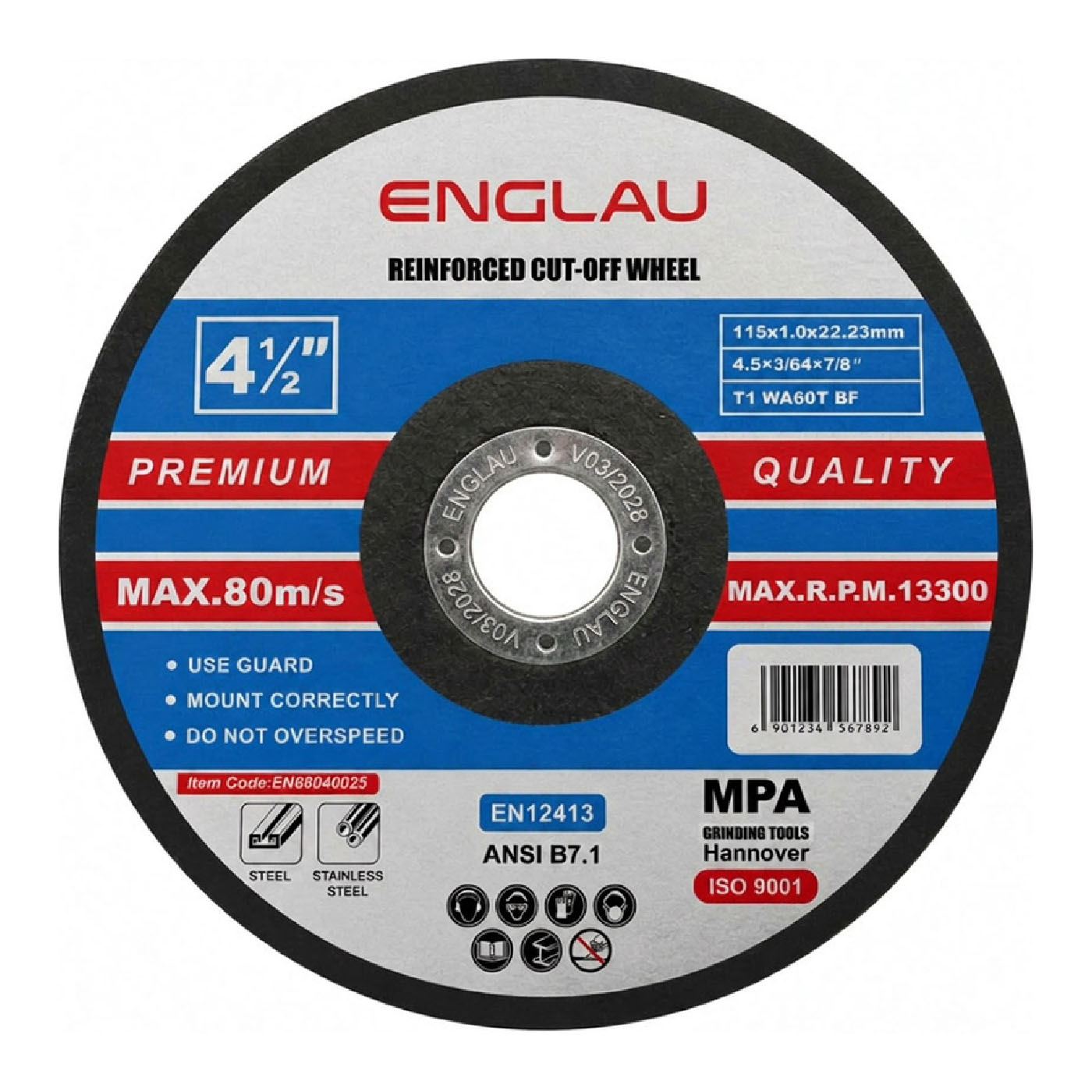
Abrasive disc cutting uses a thin, high-speed bonded abrasive cutting disc to part metal workpieces with speed, precision, and minimal material loss. It is the most widely used cutting method on construction sites and in fabrication workshops, offering the combination of portability, versatility, and cutting speed that no other method can match for on-site and small-batch work. Englau Group’s ceramic cutting discs — powered by CERAMICS Plus grain technology — represent the highest performance tier in abrasive disc cutting, delivering up to 600% longer service life and 50% faster cutting speeds than conventional discs. Their self-sharpening ceramic grain maintains aggressive cutting performance from the first cut to the last, eliminating the progressive slowdown that conventional aluminium oxide discs experience as they wear.
Why Fabricators Are Switching to Ceramic Cutting Discs
For fabricators who have used conventional aluminium oxide or zirconia alumina cutting discs throughout their careers, the performance difference of Englau Group’s ceramic cutting discs can be striking. The first thing most users notice is the cutting speed — ceramic discs cut measurably faster from the outset, requiring less operator pressure and generating less heat at the cut zone. The second thing they notice is how long the disc lasts. Where a conventional disc might need replacing after a shift, a CERAMICS Plus ceramic disc continues to perform across multiple shifts, significantly reducing the frequency of disc changes and the associated downtime.
The science behind this performance lies in the microcrystalline structure of the ceramic grain. Unlike conventional abrasive grains that become progressively blunted as they wear, ceramic grains fracture at the microcrystalline level during use, continuously exposing fresh, sharp cutting edges. This self-sharpening mechanism sustains cutting efficiency throughout the disc’s service life, delivering consistent speed and finish quality from the first cut to the last.
Our CERAMICS Plus ceramic cutting discs are available for angle grinders, bench-mounted drop saws, and air tools, in diameters from 100 mm to 400 mm and thicknesses from 1.0 mm, covering mild steel, stainless steel, and other ferrous and non-ferrous metals.
4. Bending
Bending transforms flat sheet metal blanks into three-dimensional forms by applying controlled force to deform the metal along a defined axis. The primary bending methods used in industrial fabrication are press brake bending, which uses a punch and die to form precise angles and profiles; roll forming, which progressively bends sheet metal through a series of roll stations to produce continuous profiles; and hand bending, which is used for simple bends on light-gauge material. Press brake bending is the most widely used method for structural and architectural fabrication, offering high dimensional accuracy and repeatability across a broad range of material thicknesses.
The choice of bending method is governed by the workpiece material, sheet thickness, required bend radius, dimensional tolerance, and production volume. Formed components typically exhibit edge burrs and surface marks at the bend zone that require deburring and surface conditioning before welding or assembly. Englau Group’s flap discs and non-woven surface conditioning discs are the recommended abrasive solution for post-bending edge treatment, delivering controlled material removal without distorting the formed geometry.
5. Welding and Post-Weld Treatment
Welding is the primary joining method in metal fabrication, fusing two or more metal workpieces by applying heat to create a metallurgical bond. The weld pool — formed by melting the base metal and a filler material — solidifies on cooling to form a joint with strength comparable to the parent material. Welding quality is directly dependent on the cleanliness of the joint surfaces before welding and the condition of the weld bead after welding. Pre-weld surface preparation removes mill scale, rust, and contamination that would otherwise cause weld porosity and defects. Post-weld operations — including spatter removal, slag cleaning, and weld bead dressing — restore the surface to the required condition for inspection, coating, or further assembly. Englau Group’s ceramic alumina flap discs are the recommended tool for both pre-weld preparation and post-weld dressing, delivering consistent, controlled results on carbon steel and stainless steel without the risk of overheating or surface contamination.
6. Key Competencies for Industrial Metal Fabrication
Professional metal fabrication demands a combination of technical knowledge, practical skill, and attention to detail. The following competencies are essential for consistent, high-quality performance in industrial production environments:
Welding proficiency across one or more processes — including MIG, TIG, and stick welding — with the ability to produce consistent, defect-free weld joints that meet the structural and quality requirements of the application.
Knowledge of joining methods including soldering, brazing, and mechanical fastening, and the ability to select the appropriate method for the material, joint configuration, and service requirement. Safe and effective use of a wide range of hand and power tools, including angle grinders, cutting discs, grinding wheels, and surface finishing abrasives, in accordance with applicable health and safety regulations.
Effective communication with colleagues, production supervisors, and quality inspectors, and the ability to accurately report non-conformances and production issues. Physical capability and stamina to sustain productive performance across full production shifts in demanding workshop and site environments, including the safe manual handling of metal stock, fabricated components, and power tools.
Meticulous attention to surface finish quality and weld integrity, with a commitment to producing work that consistently meets or exceeds the specification requirements of the customer or project. Practical problem-solving capability — including the ability to identify the root cause of surface finish defects, dimensional non-conformances, and abrasive tool performance issues, and to implement effective corrective actions without disrupting production flow.
· Problem-solving skills.
Frequently Asked Questions
What ceramic cutting disc products does Englau Group offer?
Englau Group offers a comprehensive range of bonded abrasive cutting discs, including ultra-thin ceramic cutting discs from 1.0 mm thickness and up to 400 mm in diameter, powered by our proprietary CERAMICS Plus ceramic alumina grain technology. We also supply standard cutting discs in aluminium oxide, zirconia alumina, and silicon carbide grain types. Please contact our team for a full product catalogue and specification sheet.
What materials are the Englau Group abrasive wheels suitable for?
Englau Group abrasive wheels are formulated for use on carbon steel, stainless steel, aluminium, cast iron, titanium alloys, stone, concrete, and composite materials. Our application engineering team can recommend the optimal grain type and specification for your specific workpiece material and operating conditions.
What grit sizes are available?
Our coated and non-woven abrasive products are available in a wide range of grades and grit sizes to meet specific application requirements. Typical grit sizes offered include P36 to P1200 for coated abrasives and medium to ultra-fine grades for non-woven materials, covering most common needs from heavy stock removal to fine finishing. For specialised applications or the full range of available sizes, please contact us for our complete product specification sheet.
Are your products certified to international standards?
Yes. All Englau Group abrasive products are manufactured in strict accordance with the German EN 12413 standard, one of the most stringent quality certifications in the global abrasives industry. This standard governs safety and performance requirements for bonded abrasive tools, guaranteeing structural strength, operational safety, and uniform quality across our product range.
Can I request product samples or technical datasheets?
Yes. We welcome sample requests and can provide detailed technical datasheets for all product categories. Standard product samples are provided free of charge for qualified business customers. Shipping costs for samples are typically borne by the requester, and we will confirm shipping arrangements and options during your inquiry process. Please contact our team directly with your product requirements, and we will respond within 3–5 business days.
Does Englau Group offer application-specific or custom formulations?
Yes. With over 20 years of experience, we develop market-specific, application-optimised formulations tailored to customers’ unique usage conditions and performance requirements. To request a custom formulation, buyers are invited to contact our technical team with details of their intended application, material type, and specific performance goals. Our workflow includes initial technical consultation, proposed specification and sample development, and performance validation on the customer's production line. Upon customer approval, full-scale production begins. The typical timeline for this process is 2–3 weeks for initial formulation and sample delivery, with overall lead times varying based on the complexity of the requirements. Our team keeps you informed at each step to ensure a transparent and efficient experience.
Do you accept OEM orders and private label manufacturing?
Yes. Englau Group supports full OEM manufacturing and can produce our complete range of abrasive products under your brand, with custom labelling, packaging design, and product specifications customised to your market requirements. The minimum order quantity is 1,000 pieces per item. Our typical OEM process includes an initial requirements discussion, confirmation of artwork and product specifications, sample production and approval, and bulk manufacturing and shipment. The lead time is usually 2–3 weeks for sample development after requirements are finalised, and 4–6 weeks for bulk production after sample approval. Timelines may vary depending on order complexity and customisation needs, so we encourage customers to share their specific project requirements for accurate scheduling.
For technical inquiries, product specifications, sample requests, or OEM discussions, please contact Englau Group directly:
Mr. Eric Lau
President, Englau Group Co., Limited
Room 1205, 12/F, 130-132 Des Voeux Road Central, Hong Kong
Phone: +86 137 7034 5768
Email: eric.twintrade@gmail.com