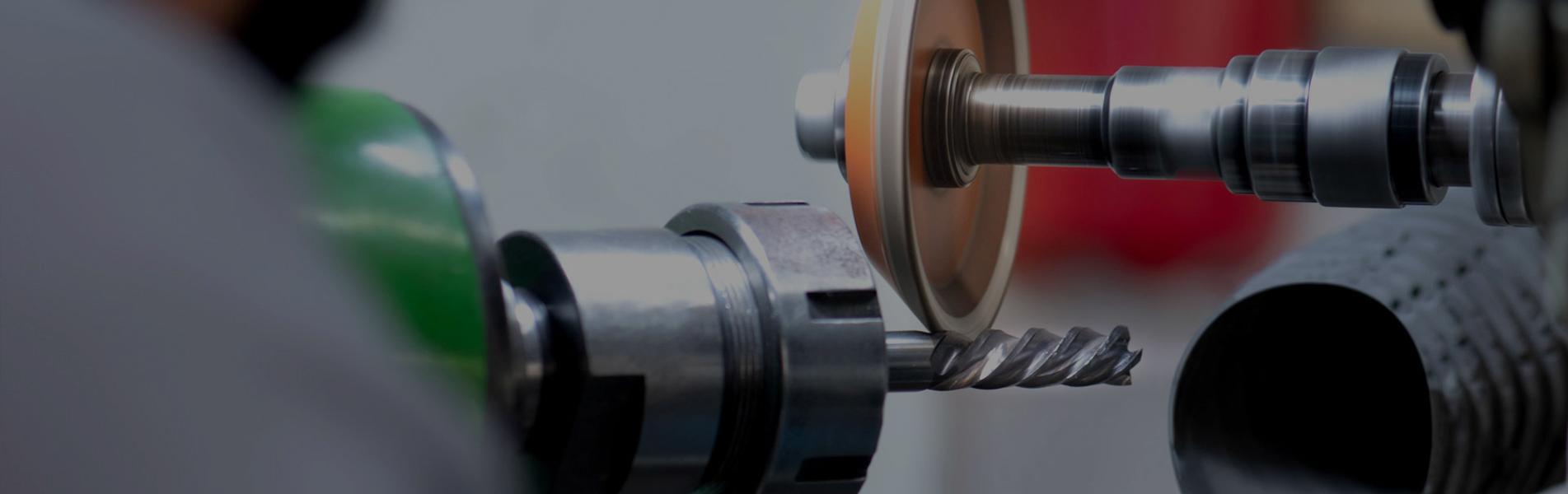
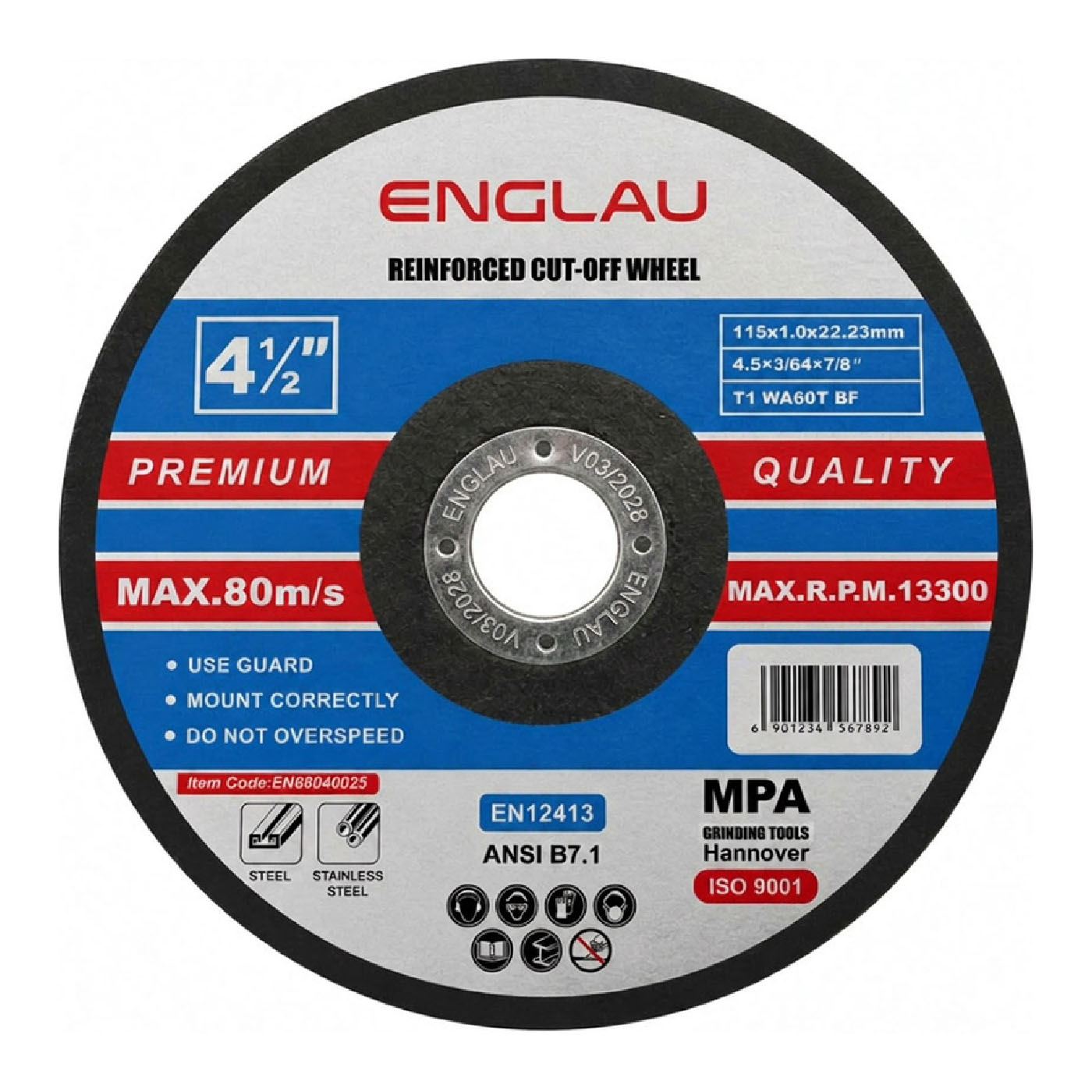
With over 20 years of expertise in the abrasives and industrial tooling industry, Englau Group designs, manufactures, and exports a comprehensive range of high-performance surface treatment solutions to industrial customers worldwide. Our core product range spans ceramic extra-thin cutting discs, standard cutting discs, grinding wheels, flap discs, fibre discs, non-woven abrasives, coated sanding belts, and wire brushes — each engineered to deliver consistent performance, extended tool life, and measurable productivity gains across the most demanding industrial applications.
Our ceramic extra-thin cutting discs, powered by proprietary CERAMICS Plus grain technology, are the tool of choice for precise, fast cutting of metal components in automotive and aerospace manufacturing. Standard cutting discs and grinding wheels deliver reliable heavy-duty performance in structural steel fabrication, shipbuilding, and construction. Flap discs and fibre discs provide effective weld dressing and surface finishing in metalworking and equipment assembly, while nonwoven abrasives and coated sanding belts are widely specified for stainless steel fabrication, furniture manufacturing, and construction material processing. Our wire brushes meet the requirements for rust removal, deburring, and weld cleaning across construction sites, maintenance workshops, and industrial facilities.
All Englau Group products are manufactured in strict accordance with the German EN 12413 standard, a globally recognized benchmark for abrasive tool safety and performance. Our application engineering team works directly with industrial customers to optimize grain formulations, define precise product specifications, and provide technical support to maximise operational efficiency and tool service life.
Industrial customers can access Englau Group’s technical support directly by contacting our application engineering team by phone or email. Our engineers will review your specific production requirements or surface treatment challenges and recommend tailored abrasive solutions and process optimisations. Follow-up consultations are available to validate performance outcomes and provide ongoing support as your production needs evolve.
The Six Core Metal Fabrication Processes
Before a raw metal material can be used in manufacturing and assembly, it must undergo one or more fabrication processes to achieve the required geometry, surface condition, and mechanical properties. The six core metal fabrication processes — cutting, metal stamping, welding, extrusion, forging, and casting — each serve a distinct purpose and are frequently used in combination to produce complex finished components. Understanding these processes and the abrasive tooling requirements associated with each is essential for fabricators seeking to optimize their production workflows and surface finish outcomes.
Englau Group supplies abrasive solutions that support fabricators at every stage of the metal fabrication process — from initial cutting and edge preparation through to post-weld dressing and final surface finishing. The following guide covers each process in detail, with practical abrasive recommendations where Englau Group products can add measurable value.
1. Cutting
Cutting is the foundational process of metal fabrication — the step that transforms raw stock, sheet, plate, and structural profiles into the blank shapes and sections required for all subsequent fabrication operations. While the concept is straightforward, modern metal cutting encompasses a wide range of methods, from manual sawing and mechanical shearing to laser, plasma, and abrasive disc cutting, each suited to different materials, thicknesses, and precision requirements.
For on-site and workshop cutting of steel sections, pipe, rebar, and structural profiles, angle-grinder cutting discs and petrol-cut-off-saw discs remain the most practical and widely used tools in the fabricator’s arsenal. The choice of cutting disc — in terms of grain type, thickness, and diameter — has a direct, measurable impact on cut quality, cutting speed, heat generation, and total consumable cost.
Englau Group’s cutting disc range covers every metal cutting requirement in the fabrication workshop and on the construction site. Our ultra-thin cutting discs — available in 1.0 mm thickness with standard aluminum oxide, zirconia alumina, and CERAMICS Plus ceramic alumina grains — deliver clean, burr-free cuts on carbon steel, stainless steel, aluminum, and cast iron with minimal heat generation and kerf loss. For heavy-section structural cutting, our large-diameter discs up to 400 mm are specifically engineered for petrol cut-off saws and bench-mounted drop saws, delivering the cutting capacity and peripheral speed rating required for demanding site and workshop applications. All Englau Group cutting discs are manufactured in compliance with EN 12413 and clearly marked with maximum operating speed ratings for safe, confident selection.
Cutting operations remove unwanted material from the workpiece to achieve the required blank shape, section length, or profile. The process applies equally to ferrous metals — carbon steel, stainless steel, and cast iron — and non-ferrous metals including aluminum, copper, and brass. Once cut to the required dimensions, the workpiece is ready for the next fabrication stage: forming, joining, or surface finishing.
Common cutting applications in metal fabrication include parting sheet metal blanks, cutting structural steel sections and reinforcing bars, sectioning pipe and tube, and trimming formed components to final dimensions. The choice of cutting method — whether abrasive disc, mechanical saw, laser, or plasma — depends on the material type, section thickness, required cut quality, and available equipment.
2. Metal Stamping
Metal stamping is a high-volume sheet metal forming process in which a press tool — comprising a punch and die — is used to cut, form, or emboss sheet metal into precise, repeatable shapes. It is applicable to a wide range of sheet metal materials, including carbon steel, stainless steel, aluminum, copper, brass, and galvanized alloys, and is frequently used in combination with other fabrication processes to produce complex finished components.
Metal stamping is most extensively used in the automotive industry, where it produces high volumes of body panels, structural reinforcements, and mechanical components — including doors, bonnets, boot lids, wheel hubs, and firewall panels — with the dimensional consistency and surface quality required for automated assembly and painting. The high repeatability and speed of stamping make it the preferred process for applications that require large quantities of identical sheet-metal components.
Beyond standard production, metal stamping tooling can be designed to produce highly customized profiles and geometries, making it a versatile process for both mass production and specialist component manufacture. Stamped components typically require edge deburring and surface conditioning after pressing — operations for which Englau Group’s flap discs and non-woven surface conditioning discs are the recommended abrasive solution, delivering controlled, consistent results without altering the stamped geometry.
3. Welding
Welding is the primary metal joining process in industrial fabrication, fusing two or more metal workpieces by applying heat, pressure, or both to create a metallurgical bond. Modern welding encompasses a range of processes — including Gas Metal Arc Welding (GMAW/MIG), Gas Tungsten Arc Welding (GTAW/TIG), Shielded Metal Arc Welding (SMAW/stick), and flux-cored arc welding — each suited to different materials, joint configurations, and quality requirements. All welding processes require consumables including shielding gas, electrodes or wire, and in many cases flux and filler materials.
Weld quality is directly influenced by the cleanliness of the joint surfaces before welding and the condition of the weld zone after welding. Pre-weld surface preparation — removing mill scale, rust, paint, and contamination from the joint area — is essential to achieving sound, defect-free welds. Post-weld operations including spatter removal, slag cleaning, and weld bead dressing are equally important for both structural integrity and surface finish quality. Englau Group’s ceramic alumina flap discs and non-woven surface conditioning discs are specifically recommended for pre-weld preparation and post-weld dressing on carbon steel and stainless steel, delivering the surface quality required for strong, consistent weld joints.
Welded assemblies are found in virtually every industrial sector — from structural steelwork, pressure vessels, and pipework in construction and process industries, to chassis frames and body structures in automotive manufacturing, to airframe assemblies in aerospace. The ubiquity of welding in industrial fabrication makes abrasive weld dressing tools one of the most consistently demanded product categories in the Englau Group range.
4. Extrusion
Extrusion is a forming process in which a heated metal billet is forced through a shaped die under high hydraulic pressure to produce a continuous profile with a consistent cross-section. While the process is also used for plastics and polymers, metal extrusion is most widely associated with aluminum, which extrudes readily due to its relatively low flow stress and excellent formability at elevated temperatures.
The extruded profile emerges from the die at elevated temperature and is subsequently quenched, stretched for straightness, and cut to length. Post-extrusion operations — including surface finishing, anodizing, powder coating, and precision machining — are commonly required to achieve the final surface quality and dimensional tolerances specified by the customer. Englau Group’s silicon carbide and aluminum oxide-coated abrasives are well-suited for surface preparation of aluminum extrusions prior to anodizing or coating, delivering consistent scratch patterns and the surface cleanliness required for optimal coating adhesion.
Aluminum extrusions are among the most versatile and widely used structural and architectural products in modern manufacturing, finding application in window and door frames, curtain wall systems, louvres, handrails, solar panel frames, heat sinks, and structural sections across construction, transportation, and electronics industries. The combination of aluminum’s natural corrosion resistance and the additional protection of anodizing or powder coating makes extruded aluminum profiles a durable, low-maintenance solution for both interior and exterior applications.
5. Forging
Forging is one of the oldest and most reliable metal shaping processes, with origins that predate recorded industrial history. In its modern industrial form, forging uses controlled compressive forces — applied by hydraulic or mechanical presses, or by drop hammers — to shape heated or cold metal billets into precise, high-strength components with superior mechanical properties compared to cast or machined alternatives.
The compressive forces applied during forging align the metal’s grain structure to follow the component’s geometry, producing a refined, directional grain flow that significantly enhances fatigue strength, impact resistance, and toughness compared to castings or machined bar stock. Common forging techniques include open-die forging for large, simple shapes, closed-die (impression die) forging for precise near-net-shape components, and cold forging for high-volume production of small, precise parts at room temperature. Forged components typically require post-forge surface finishing to remove scale, flash, and surface irregularities — operations for which Englau Group’s grinding wheels and fibre discs provide the aggressive stock removal and surface conditioning performance required.
6. Casting
Metal casting is a near-net-shape manufacturing process in which molten metal is poured into a precisely designed mould cavity and allowed to solidify, producing a component that closely approximates the final geometry with minimal subsequent machining. Casting is particularly well-suited to producing complex three-dimensional shapes — including internal cavities, undercuts, and intricate surface details — that would be difficult or uneconomical to achieve through machining, forging, or fabrication.
The primary advantage of casting is its ability to produce complex geometries in a single operation, making it the preferred process for components such as engine blocks, cylinder heads, pump housings, valve bodies, gearbox casings, and turbine blades across automotive, aerospace, agricultural, and industrial equipment sectors. High-volume casting processes — including die casting, investment casting, and sand casting — each offer different balances of dimensional accuracy, surface finish quality, and production cost.
The heating and solidification cycle inherent to casting can introduce internal stresses, porosity, and surface defects that require post-casting treatment. Fettling — the removal of gates, risers, flash, and surface irregularities from castings — is a critical post-process operation that relies heavily on abrasive grinding. Englau Group’s depressed centre grinding wheels and fibre discs are widely used in foundry fettling operations, delivering the aggressive stock-removal rates and durability required to efficiently and consistently process high volumes of cast components.
Cutting vs. Grinding Discs — Selecting the Right Tool for the Job
One of the most important — and most frequently misunderstood — tool selection decisions in metal fabrication is the choice between a cutting disc and a grinding disc. These two product types are engineered for fundamentally different operations, and using the wrong disc is not merely inefficient: it is a serious safety hazard. Ultra-thin cutting discs lack the lateral strength to withstand side pressure and can disintegrate at high velocity if subjected to grinding forces for which they were not designed.
Englau Group’s cutting and grinding disc range covers both categories in full, with clear product specifications and EN 12413 safety markings to guide correct selection. The following comparison outlines the key differences between cutting and grinding discs to support safe, informed tool selection:
Cutting discs, also known as cut-off wheels, are designed for fast, clean, straight parting of material. Their thickness typically ranges from 1.0 mm to 3.2 mm, and they are operated perpendicular to the workpiece at 90 degrees, using only the outer edge. They cannot withstand side pressure. Englau Group’s CERAMICS Plus ultra-thin cutting discs, available from 1.0 mm thickness, deliver up to 600% longer service life and 50% faster cutting speeds compared to conventional alternatives.
Grinding discs, or grinding wheels, are designed for removing material, smoothing welds, and shaping surfaces. Their thickness typically ranges from 4 mm to 8 mm, with 6 mm being the most common specification. They are operated at a shallow angle of 15 to 30 degrees to the workpiece, using the face of the disc, and are built to withstand lateral grinding pressure. Englau Group’s depressed centre grinding wheels (Type 27) in ceramic alumina and zirconia alumina are recommended for heavy stock removal and weld dressing on carbon steel and stainless steel.
Specialized Disc Types and Englau Group Recommendations
Beyond standard cutting and grinding discs, professional fabricators rely on a range of specialized abrasive disc types for specific surface treatment requirements. Englau Group supplies all of the following specialized disc types as part of our comprehensive fabrication abrasive range:
Flap discs are constructed from overlapping abrasive flap segments bonded to a fibreglass or plastic backing plate, combining the cutting action of coated abrasives with the flexibility of a conformable disc geometry. They deliver an outstanding balance of material removal and surface finish quality, making them the tool of choice for weld bead blending, burr removal, edge deburring, and surface conditioning on fabricated components. Englau Group’s ceramic alumina and zirconia alumina flap discs are available in Type 27 (flat) and Type 29 (conical) profiles across a full grit range from P40 to P120.
Wire wheels and cup brushes are used for aggressive surface cleaning — removing rust, mill scale, weld spatter, and old paint coatings from metal surfaces without significant removal of base metal. Englau Group’s steel wire brushes are available in twist-knot and crimped wire configurations for angle grinders and bench grinders, providing the cleaning action required for surface preparation prior to welding, coating, and inspection.
Non-woven surface conditioning discs and strip discs are constructed from an open, three-dimensional nylon fibre web impregnated with abrasive grain. Their open structure resists clogging and generates minimal heat, making them ideal for stripping epoxy coatings, adhesive residues, and paint from metal surfaces without damaging the substrate. Englau Group’s non-woven abrasive range provides the controlled, gentle surface conditioning action required for pre-treatment operations on stainless steel, aluminum, and sensitive metal surfaces.
Diamond cutting and grinding discs use manufactured diamond abrasive — the hardest known material — bonded to a steel substrate using sintered metal or electroplated bond systems. They are the recommended solution for cutting and grinding extremely hard or abrasive materials, including concrete, masonry, ceramics, glass, and high-density engineered materials, where conventional bonded abrasives would wear too rapidly to be cost-effective.
Material-Specific Abrasive Selection — Englau Group Guidance
For stainless steel, abrasive tools must be free of iron, sulphur, and chlorine contamination — all of which can initiate corrosion on the stainless surface. Englau Group's INOX-grade cutting discs and flap discs contain less than 0.1% of these contaminants and are clearly labelled for stainless steel use. Our ceramic alumina grain is specifically recommended for stainless steel applications, as its self-sharpening mechanism delivers a cooler cutting action that minimizes heat discoloration and preserves the corrosion resistance of the stainless surface.
For aluminum, the material’s ductility and low melting point make it highly susceptible to wheel loading — the adhesion of aluminum swarf to the abrasive surface that progressively reduces cutting efficiency and generates excessive heat. Englau Group’s silicon carbide cutting discs and open-structure coated abrasives are specifically formulated for aluminum applications, with grain types and bond systems that resist loading and maintain cutting performance throughout the disc’s service life.
Carbon Steel: For general-purpose cutting and grinding of carbon steel, zirconia alumina and aluminum oxide are the standard grain choices, offering a reliable balance of cutting speed, surface finish quality, and tool life. For the most demanding carbon steel cutting and grinding applications — where maximum productivity and lowest cost per cut are the priority — Englau Group’s CERAMICS Plus ceramic alumina products are the recommended upgrade, delivering up to 600% longer service life and 50% faster cutting speeds compared to conventional aluminum oxide alternatives.
Critical Safety Practices for Cutting and Grinding Operations
Ultra-thin cutting discs are designed exclusively for straight, perpendicular cutting operations and must never be used for grinding. They lack the structural depth and lateral strength to withstand the side-loading forces generated during grinding. Using a cutting disc for grinding can cause catastrophic disc disintegration, ejecting high-velocity fragments that can cause fatal injuries. Englau Group’s grinding wheels are specifically engineered for grinding operations and must be used in place of cutting discs for any operation involving lateral contact with the workpiece.
All abrasive discs must be visually inspected for cracks, chips, nicks, and signs of impact damage before mounting. A damaged disc can disintegrate at operating speed, with fragments reaching velocities exceeding 160 km/h. Discs that have been dropped, stored incorrectly, or used beyond their expiry date must be withdrawn from service immediately. Englau Group recommends that all abrasive wheels are stored in dry conditions, away from impact hazards, and that expiry dates are checked before each use.
Every Englau Group abrasive disc is clearly marked with its maximum operating speed in both RPM and m/s, and this rating must always exceed the grinder’s no-load speed. Operating a disc above its rated speed dramatically increases the risk of disc disintegration. Never use a disc on a machine whose no-load speed exceeds the disc’s maximum RPM rating.
The following personal protective equipment is mandatory for all cutting and grinding operations: a full-face shield worn over safety glasses rated to EN 166 or ANSI Z87.1, to protect against ejected particles and disc fragments; leather or cut-resistant gloves to protect against heat and sharp edges; hearing protection rated to EN 352 in environments where noise levels exceed 85 dB(A); and close-fitting workwear with no loose sleeves, ties, or jewellery that could be drawn into the rotating disc.
Frequently Asked Questions
What abrasive wheel types does Englau Group offer?
Englau Group offers a comprehensive range of bonded abrasive wheels, including straight grinding wheels (Type 1), depressed centre grinding wheels (Type 27), ultra-thin cutting discs from 1.0 mm, and large-diameter cutting discs up to 400 mm. Available grain types include aluminium oxide, zirconia alumina, silicon carbide, and our proprietary CERAMICS Plus ceramic alumina. Please contact our team for a full product catalogue and specification sheet.
What materials are the Englau Group abrasive wheels suitable for?
Englau Group abrasive wheels are formulated for use on carbon steel, stainless steel, aluminium, cast iron, titanium alloys, stone, concrete, and composite materials. Our application engineering team can recommend the optimal grain type and specification for your specific workpiece material and operating conditions.
What grit sizes are available?
Our coated and non-woven abrasive products are available in a wide range of grades and grit sizes to meet specific application requirements. Typical grit sizes offered include P36 to P1200 for coated abrasives and medium to ultra-fine grades for non-woven materials, covering most common needs from heavy stock removal to fine finishing. For specialised applications or the full range of available sizes, please contact us for our complete product specification sheet.
Are your products certified to international standards?
Yes. All Englau Group abrasive products are manufactured in strict accordance with the German EN 12413 standard, one of the most stringent quality certifications in the global abrasives industry. This standard governs safety and performance requirements for bonded abrasive tools, guaranteeing structural strength, operational safety, and uniform quality across our product range.
Can I request product samples or technical datasheets?
Yes. We welcome sample requests and can provide detailed technical datasheets for all product categories. Standard product samples are provided free of charge for qualified business customers. Shipping costs for samples are typically borne by the requester, and we will confirm shipping arrangements and options during your inquiry process. Please contact our team directly with your product requirements, and we will respond within 3–5 business days.
Does Englau Group offer application-specific or custom formulations?
Yes. With over 20 years of experience, we develop market-specific, application-optimised formulations tailored to customers’ unique usage conditions and performance requirements. To request a custom formulation, buyers are invited to contact our technical team with details of their intended application, material type, and specific performance goals. Our workflow includes initial technical consultation, proposed specification and sample development, and performance validation on the customer's production line. Upon customer approval, full-scale production begins. The typical timeline for this process is 2–3 weeks for initial formulation and sample delivery, with overall lead times varying based on the complexity of the requirements. Our team keeps you informed at each step to ensure a transparent and efficient experience.
Do you accept OEM orders and private label manufacturing?
Yes. Englau Group supports full OEM manufacturing and can produce our complete range of abrasive products under your brand, with custom labelling, packaging design, and product specifications customised to your market requirements. The minimum order quantity is 1,000 pieces per item. Our typical OEM process includes an initial requirements discussion, confirmation of artwork and product specifications, sample production and approval, and bulk manufacturing and shipment. The lead time is usually 2–3 weeks for sample development after requirements are finalised, and 4–6 weeks for bulk production after sample approval. Timelines may vary depending on order complexity and customisation needs, so we encourage customers to share their specific project requirements for accurate scheduling.
For technical inquiries, product specifications, sample requests, or OEM discussions, please contact Englau Group directly:
Mr. Eric Lau
President, Englau Group Co., Limited
Room 1205, 12/F, 130-132 Des Voeux Road Central, Hong Kong
Phone: +86 137 7034 5768
Email: eric.twintrade@gmail.com