About the Englau Group
With over 20 years of expertise in the abrasives and industrial tooling industry, Englau Group designs, manufactures, and exports a comprehensive range of high-performance surface treatment solutions to industrial customers worldwide. Our core product range spans ceramic extra-thin cutting discs, standard cutting discs, grinding wheels, flap discs, fibre discs, non-woven abrasives, coated sanding belts, and wire brushes — each engineered to deliver consistent performance, extended tool life, and measurable productivity gains across the most demanding industrial applications.
Our ceramic extra-thin cutting discs, powered by proprietary CERAMICS Plus grain technology, are the tool of choice for precise, fast cutting of metal components in automotive and aerospace manufacturing. Standard cutting discs and grinding wheels deliver reliable heavy-duty performance in structural steel fabrication, shipbuilding, and construction. Flap discs and fibre discs provide effective weld dressing and surface finishing in metalworking and equipment assembly, while nonwoven abrasives and coated sanding belts are widely specified for stainless steel fabrication, furniture manufacturing, and construction material processing. Our wire brushes meet the requirements for rust removal, deburring, and weld cleaning across construction sites, maintenance workshops, and industrial facilities.
All Englau Group products are manufactured in strict accordance with the German EN 12413 standard, which is a globally recognized benchmark for abrasive tool safety and performance. Our application engineering team works directly with industrial customers to optimize grain formulations, define precise product specifications, and provide technical support to maximize operational efficiency and tool service life.
Industrial customers can access Englau Group’s technical support directly by contacting our application engineering team by phone or email. Our engineers will review your specific production requirements or surface treatment challenges and recommend tailored abrasive solutions and process optimizations. Follow-up consultations are available to validate performance outcomes and provide an understanding of Abrasive Material Types — A Guide for Industrial Users.
Types of Abrasive Materials
Selecting the right abrasive material is one of the most consequential decisions in any industrial surface treatment operation. Get it right, and you achieve the required surface finish efficiently, at the right cost, with consistent results. Get it wrong, and you face premature tool wear, poor surface quality, rework, and unnecessary downtime.
The fundamental principle of abrasive action is straightforward: the abrasive grain must be harder than the workpiece material it is cutting or finishing. Beyond that basic requirement, however, the choice of abrasive material, grain type, and product form has a profound influence on cutting speed, surface finish quality, tool life, and total operating cost. At Englau Group, we work with industrial customers every day to navigate these choices — and the guidance in this article reflects two decades of application experience across metalworking, fabrication, construction, automotive, and aerospace sectors.
Natural and Synthetic Abrasive Materials
Abrasive materials are broadly classified into two categories: natural abrasives, which occur in nature and are used with varying degrees of refinement, and synthetic abrasives, which are manufactured through controlled industrial processes to achieve precise, consistent performance characteristics. In professional industrial applications, synthetic abrasives dominate, as their uniformity of hardness, grain morphology, and cutting behaviour makes them far more predictable and controllable than natural alternatives.
Naturally occurring abrasive minerals include garnet, emery, pumice, calcite, and sandstone. While these materials have been used in abrasive applications for centuries, their variable hardness and inconsistent grain structure limit their suitability for precision industrial work. Today, natural abrasives are primarily used in light-duty finishing, woodworking, and hand sanding applications.
Synthetic abrasives — including aluminum oxide, silicon carbide, zirconia alumina, ceramic alumina, cubic boron nitride (CBN), and manufactured diamond — are the materials of choice for industrial manufacturing, fabrication, and construction. Their controlled production processes deliver consistent hardness, grain size, and cutting geometry, enabling reliable, repeatable performance across high-volume production environments. Englau Group’s abrasive product range is built entirely on synthetic abrasive grains, selected and formulated to deliver optimum performance for each specific industrial application.
Bonded Abrasives
Bonded abrasives are manufactured by consolidating abrasive grains within a matrix of vitrified glass, phenolic resin, or rubber, forming a rigid, self-sustaining tool body. This construction gives bonded abrasives the structural integrity required to operate at high peripheral speeds, enabling aggressive material removal rates that no other abrasive form can match.
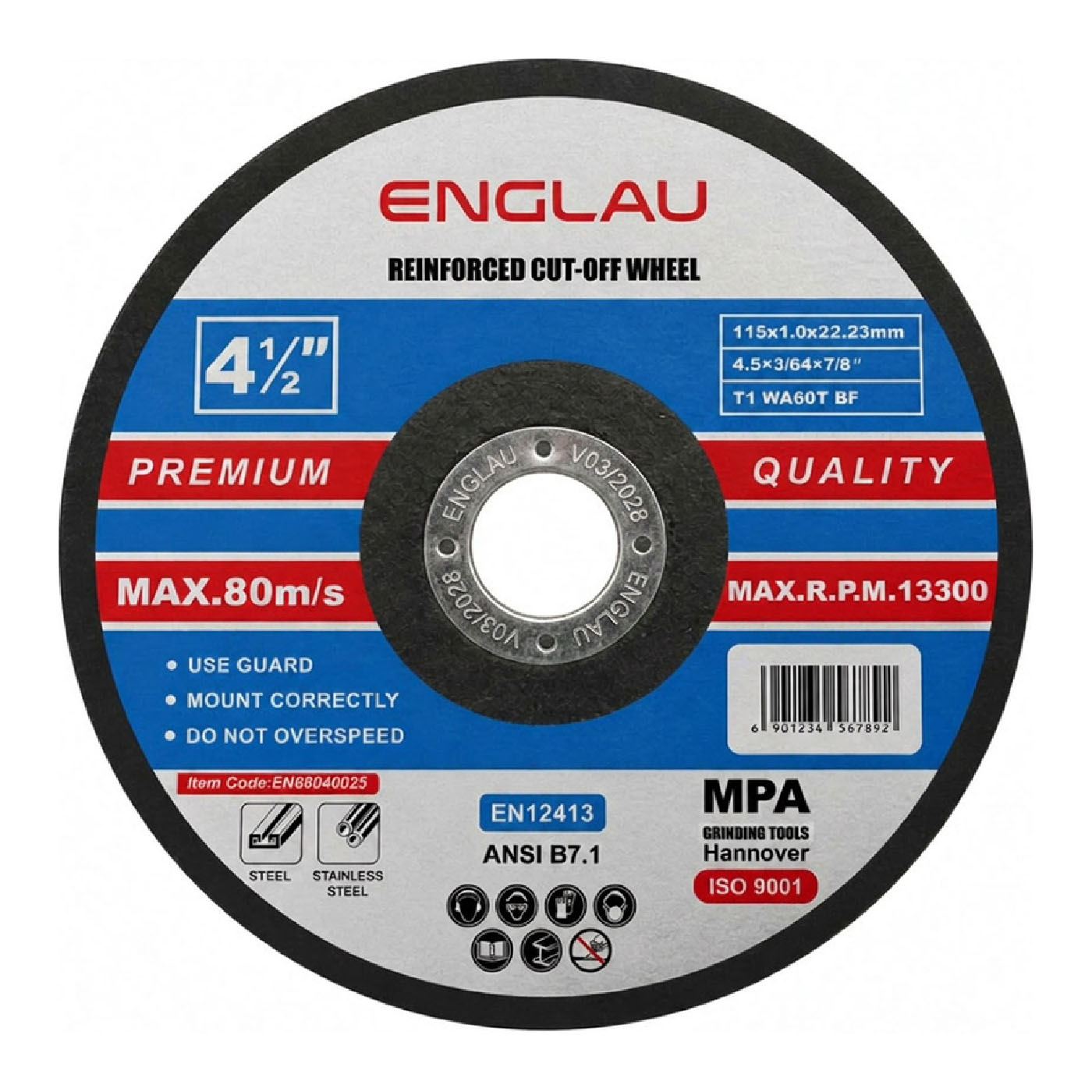
The most common bonded abrasive products are grinding wheels and cutting discs, which operate at peripheral speeds of up to 80 m/s on angle grinders and stationary machines. The bond matrix gradually releases worn grains during operation, continuously exposing fresh cutting edges — a self-dressing mechanism that sustains cutting performance throughout the tool’s service life.
Englau Group’s bonded abrasive range includes straight grinding wheels (Type 1), depressed centre grinding wheels (Type 27), and ultra-thin cutting discs with a thickness of 1.0 mm. Available in aluminum oxide, zirconia alumina, silicon carbide, and our proprietary CERAMICS Plus ceramic alumina grain, our bonded abrasives are manufactured in compliance with EN 12413 and are compatible with all standard angle grinders, bench grinders, and stationary grinding machines. For heavy-duty industrial cutting and grinding applications, Englau Group’s bonded abrasive wheels deliver the combination of cutting speed, surface finish quality, and tool life that production environments demand.
Coated Abrasives
Coated abrasives are manufactured by bonding abrasive grains to a flexible backing material — such as paper, cloth, polyester film, or vulcanized fibre — using a resin or adhesive bond system applied in two stages: the make coat, which anchors the grain to the backing, and the size coat, which locks the grain in position and provides the required physical strength and heat resistance.
The flexibility and conformability of coated abrasives make them the preferred choice for surface finishing, blending, and polishing operations where the abrasive must follow the contours of the workpiece. Common coated abrasive product forms include sanding belts, flap discs, fibre discs, sanding sheets, and rolls — each suited to specific machine types and application requirements.
Englau Group’s coated abrasive range includes flap discs in ceramic alumina, zirconia alumina, and aluminum oxide grain, fibre discs for aggressive stock removal and rust removal, and coated sanding belts for timber, metal, and composite surface finishing. Our non-woven abrasive products complement the coated range, providing controlled surface conditioning and finishing without altering workpiece dimensions — ideal for deburring, cleaning, and pre-treatment operations across metalworking, automotive, and stainless steel fabrication environments.
Loose and Applied Abrasives
Beyond bonded and coated forms, abrasives are also used in loose or applied forms for specialized industrial processes. Abrasive blasting — using media such as steel shot, glass beads, aluminum oxide grit, or garnet — is widely used for large-scale surface preparation of steel structures, bridges, and industrial equipment prior to protective coating application. Lapping and honing compounds use fine abrasive particles suspended in oil or paste to achieve extremely precise surface finishes and dimensional tolerances on precision-engineered components. While Englau Group’s primary product focus is bonded and coated abrasives, our application engineering team can provide guidance on abrasive media selection for blasting and lapping applications as part of our broader surface treatment consultancy service.
- Choosing the Right Abrasive Material — Englau Group’s Guidance for Industrial Buyers
- With three distinct abrasive forms — bonded, coated, and loose — and a wide range of grain types available within each, selecting the right abrasive for your application can feel complex. In our experience, the most effective approach is to start with the workpiece material and the required surface finish outcome, and work backwards from there.
- For aggressive material removal on ferrous metals, our ceramic alumina and zirconia alumina bonded abrasives deliver the highest stock removal rates and longest tool life. For surface finishing and blending on stainless steel, our ceramic alumina flap discs in medium to fine grit produce a consistent, high-quality finish with minimal heat input. For non-ferrous metals, composites, and stone, our silicon carbide products provide the sharp, fast cutting action these materials require. And for applications where surface conditioning without dimensional change is needed, our non-woven abrasive range delivers controlled, repeatable results.
- We encourage industrial buyers to contact our application engineering team before making a final abrasive specification decision. A short conversation about your material, machine, and finish requirements can save significant time and cost — and in many cases, we can arrange a structured application trial to demonstrate the performance of our recommended product in your own production environment.
Frequently Asked Questions
What abrasive wheel types does Englau Group offer?
Englau Group offers a comprehensive range of bonded abrasive wheels, including straight grinding wheels (Type 1), depressed centre grinding wheels (Type 27), ultra-thin cutting discs from 1.0 mm, and large-diameter cutting discs up to 400 mm. Available grain types include aluminum oxide, zirconia alumina, silicon carbide, and our proprietary CERAMICS Plus ceramic alumina. Please contact our team for a full product catalogue and specification sheet.
What materials are the Englau Group abrasive wheels suitable for?
Englau Group abrasive wheels are formulated for use on carbon steel, stainless steel, aluminum, cast iron, titanium alloys, stone, concrete, and composite materials. Our application engineering team can recommend the optimal grain type and specification for your specific workpiece material and operating conditions.
What grit sizes are available?
Our coated and non-woven abrasive products are available in a wide range of grades and grit sizes to meet specific application requirements. Typical grit sizes offered include P36 to P1200 for coated abrasives and medium to ultra-fine grades for non-woven materials, covering most common needs from heavy stock removal to fine finishing. For specialized applications or the full range of available sizes, please contact us for our complete product specification sheet.
Are your products certified to international standards?
Yes. All Englau Group abrasive products are manufactured in strict accordance with the German EN 12413 standard, one of the most stringent quality certifications in the global abrasives industry. This standard governs safety and performance requirements for bonded abrasive tools, guaranteeing structural strength, operational safety, and uniform quality across our product range.
Can I request product samples or technical datasheets?
Yes. We welcome sample requests and can provide detailed technical datasheets for all product categories. Standard product samples are provided free of charge for qualified business customers. Shipping costs for samples are typically borne by the requester, and we will confirm shipping arrangements and options during your inquiry process. Please contact our team directly with your product requirements, and we will respond within 3–5 business days.
Does Englau Group offer application-specific or custom formulations?
Yes. With over 20 years of experience, we develop market-specific, application-optimized formulations tailored to customers’ unique usage conditions and performance requirements. To request a custom formulation, buyers are invited to contact our technical team with details of their intended application, material type, and specific performance goals. Our workflow includes initial technical consultation, proposed specification and sample development, and performance validation on the customer's production line. Upon customer approval, full-scale production begins. The typical timeline for this process is 2–3 weeks for initial formulation and sample delivery, with overall lead times varying based on the complexity of the requirements. Our team keeps you informed at each step to ensure a transparent and efficient experience.
Do you accept OEM orders and private label manufacturing?
Yes. Englau Group supports full OEM manufacturing and can produce our complete range of abrasive products under your brand, with custom labelling, packaging design, and product specifications customized to your market requirements. The minimum order quantity is 1,000 pieces per item. Our typical OEM process includes an initial requirements discussion, confirmation of artwork and product specifications, sample production and approval, and bulk manufacturing and shipment. The lead time is usually 2–3 weeks for sample development after requirements are finalized, and 4–6 weeks for bulk production after sample approval. Timelines may vary depending on order complexity and customization needs, so we encourage customers to share their specific project requirements for accurate scheduling.
For technical inquiries, product specifications, sample requests, or OEM discussions, please contact Englau Group directly:
Mr. Eric Lau
President, Englau Group Co., Limited
Room 1205, 12/F, 130-132 Des Voeux Road Central, Hong Kong
Phone: +86 137 7034 5768
Email: eric.twintrade@gmail.com