About the Englau Group
With over 20 years of expertise in the abrasives industry, Englau Group designs, manufactures, and exports a comprehensive range of high-performance abrasive solutions to industrial customers worldwide. Our core product range includes ceramic extra-thin cutting discs, standard cutting discs, grinding wheels, flap discs, fiber discs, non-woven abrasives, and coated sanding belts — each engineered to deliver consistent performance, extended tool life, and measurable productivity gains across the most demanding industrial applications.
At the forefront of our product innovation are our ceramic cutting discs and ceramic grinding wheels — product categories where Englau Group has invested heavily in grain technology, bond formulation, and disc geometry to deliver cutting and grinding performance that sets a new benchmark for industrial operations. Our CERAMICS Plus grain technology delivers up to 600% longer service life and 50% faster cutting speeds compared to conventional alternatives, providing measurable productivity gains and lower total cost of operation for industrial users.
All Englau Group products are manufactured in strict accordance with the German EN 12413 standard — a globally recognized benchmark for abrasive tool safety and performance. Our application engineering team works directly with industrial customers to optimize grain formulations, define precise product specifications, and provide technical support that maximizes operational efficiency and extends tool service life.
Introduction to Bonded Abrasive Cutting and Grinding Discs
Bonded abrasives are manufactured by consolidating abrasive grains within a matrix of vitrified glass, resin, rubber, or other binders to form a rigid, self-supporting tool body. They are the primary tool of choice for material removal operations on metal, ceramic, glass, plastic, and composite substrates across industrial manufacturing, fabrication, and maintenance environments.
Englau Group’s bonded abrasive range centers on two core product categories: cutting discs, designed for precise parting and sectioning of workpieces, and grinding wheels, engineered for stock removal, surface conditioning, and weld dressing. Both product families are available in a comprehensive range of diameters, thicknesses, grain types, and bond specifications to meet the full spectrum of industrial cutting and grinding requirements.
Cutting Disc and Grinding Wheel Geometries
Englau Group’s cutting discs and grinding wheels are available in a range of geometries, each optimized for specific machine configurations and operational requirements. Understanding the available wheel forms is essential for selecting the correct tool and ensuring safe, efficient operation.
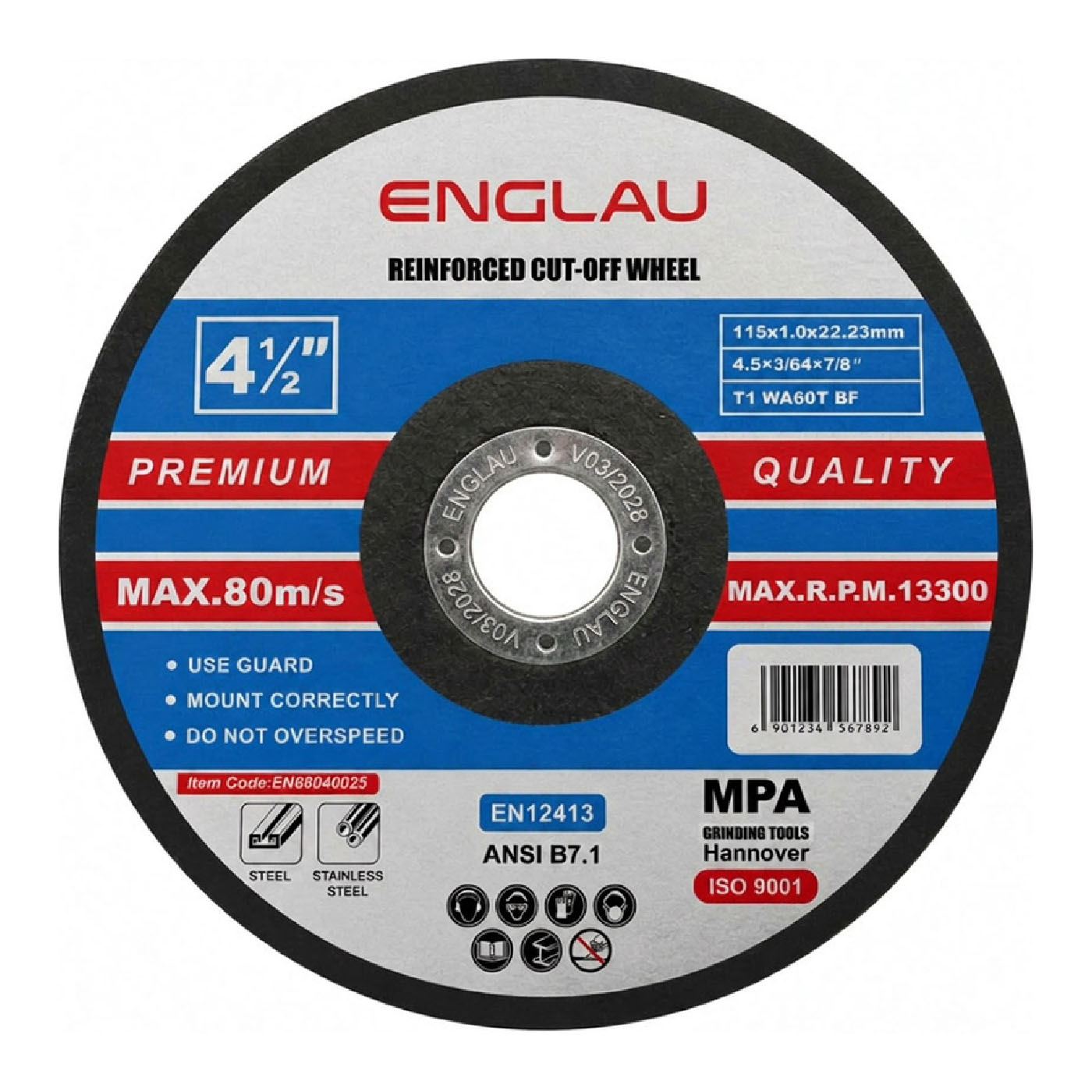
Flat wheels (Type 1) are the standard geometry for cutting discs and straight grinding wheels, with the abrasive face on the outer diameter. Englau Group’s Type 1 cutting discs are available in ultra-thin profiles from 1.0 mm, minimizing kerf loss and heat generation for clean, burr-free parting of carbon steel, stainless steel, aluminum, and cast iron.
Depressed centre wheels (Type 27 and Type 28) feature a recessed hub that provides clearance between the grinding face and the mounting flange, enabling surface grinding and weld dressing at a low grinding angle. Englau Group’s Type 27 depressed centre grinding wheels are widely used in structural fabrication, shipbuilding, and heavy metalworking for aggressive stock removal and weld seam blending on carbon steel and stainless steel.
Cup wheels present their abrasive face on the side of the wheel rather than the periphery, making them suited to surface grinding and tool sharpening operations where a broad, flat contact area is required. Both straight and flared cup wheel profiles are available, selected based on the machine configuration and the required contact geometry.
Recessed wheels incorporate a recessed centre hub on one or both sides to accommodate specific machine spindle or flange assemblies, providing additional clearance in confined grinding environments. This geometry is commonly specified for cylindrical and internal grinding applications where standard straight wheel mounting is not compatible with the machine configuration.
Tapered body wheels feature a thicker cross-section at the bore that tapers progressively toward the outer diameter, providing enhanced structural rigidity at the point of highest rotational stress. This geometry is particularly suited to cutting and grooving operations where lateral stability and resistance to disc deflection are critical to cut quality and operator safety.
Key Specification Parameters for Cutting and Grinding Discs
Grit size measures the abrasive grains in a matrix or bonded to a surface. Typically, grit sizes are based on
ANSI (U.S.), FEPA (European), JIS (Japanese), or micron-graded standards. Coarse grains, or grits, remove large amounts of material. Medium grains remove less material, but provide a better finish than coarse grits. Fine grits are suitable for light cutting and finishing, while very fine grits are used to improve the finish. The abrasive grains in bonded abrasives are bonded using several different bond types. Some use an electroplated or brazed metal bond between the abrasive grains, or between the grains of a metal substrate. Others use a shellac, resin, rubber, or glass bond system between the abrasive grains. Low-strength bonds, such as silicate, minimize heat generation but lack the life and durability of vitrified or resin bonds. Reinforced bonds use a fiberglass mesh or other fibers or materials to improve the structural integrity of bonded abrasives. Bonded abrasives use various abrasive grains.
Abrasive Grain Selection for Cutting and Grinding Discs
Abrasive grain selection is the most critical factor in cutting disc and grinding wheel specification, as it directly determines cutting speed, surface finish quality, workpiece material compatibility, and total tool life. Englau Group’s cutting discs and grinding wheels are available in four primary grain types.
Aluminum oxide is the most widely used abrasive grain in industrial bonded abrasives, offering a reliable balance of toughness, cutting efficiency, and cost-effectiveness for general-purpose grinding of ferrous metals, carbon steel, and wood-based materials. Zirconia alumina delivers superior toughness and self-sharpening behavior for high-pressure grinding of stainless steel, structural steel, and high-tensile alloys, providing significantly extended wheel life compared to standard aluminum oxide. Silicon carbide is the recommended grain for cutting and grinding non-ferrous metals, cast iron, stone, concrete, and ceramic substrates, where its extreme hardness and sharp cutting action deliver fast, clean material removal with minimal heat generation.
Englau Group’s premium CERAMICS Plus ceramic alumina grain represents the highest performance tier in our bonded abrasive range. Manufactured through an advanced sol-gel sintering process, ceramic alumina grains feature a microcrystalline structure that continuously self-sharps during operation, delivering up to 600% longer service life and 50% faster cutting speeds compared to conventional aluminum oxide. Ceramic alumina is the definitive grain choice for industrial users who require maximum productivity and the lowest cost per cut on hardened steels, stainless steel, and exotic alloys.
For superabrasive applications, Englau Group also offers CBN (Cubic Boron Nitride) grinding wheels for precision profile grinding of hardened steel components, gears, and aerospace parts that require extreme dimensional accuracy and thermal stability.
Mounting and Compatibility
Englau Group’s cutting discs and grinding wheels are supplied with standard center-bore mounting for compatibility with angle grinders, bench grinders, and stationary grinding machines from all major machine brands. All products are clearly marked with maximum operating speed (RPM and m/s) in compliance with EN 12413 safety marking requirements.
Standards
Abrasive grain in bonded abrasive products
Frequently Asked Questions
What is the difference between coated, non-woven, and bonded abrasives?
Coated abrasives have grains bonded to a flexible backing, such as paper or cloth. Non-woven abrasives embed grit within a three-dimensional nylon fiber structure for added flexibility and conformability. Bonded abrasives are solid tools, such as grinding wheels and cut-off discs, with grains consolidated into a rigid substrate.
What materials can Englau Group abrasives be used on?
Our full range of abrasive solutions is formulated for use on steel, stainless steel, aluminum, cast iron, titanium alloys, plastics, composites, coatings, and painted surfaces.
What grit sizes are available?
Our coated and non-woven abrasive products are available in a wide range of grades and grit sizes to meet specific application requirements. Typical grit sizes offered include P36 to P1200 for coated abrasives and medium to ultra-fine grades for non-woven materials, covering most common needs from heavy stock removal to fine finishing. For specialized applications or the full range of available sizes, please contact us for our complete product specification sheet.
Are your products certified to international standards?
Yes. All Englau Group abrasive products are manufactured in strict accordance with the German EN 12413 standard, one of the most stringent quality certifications in the global abrasives industry. This standard governs safety and performance requirements for bonded abrasive tools, guaranteeing structural strength, operational safety, and uniform quality across our product range.
Can I request product samples or technical datasheets?
Yes. We welcome sample requests and can provide detailed technical datasheets for all product categories. Please contact our team directly with your product requirements, and we will respond within 3–5 business days.
Does Englau Group offer application-specific or custom formulations?
Yes. With over 20 years of experience, we develop market-specific, application-optimized formulations tailored to customers’ unique usage conditions and performance requirements.
Do you accept OEM orders and private label manufacturing?
Yes. Englau Group supports full OEM manufacturing and can produce our complete range of abrasive products under your brand, with custom labeling, packaging design, and product specifications customized to your market requirements. The minimum order quantity is 1,000 pieces per item.
For technical inquiries, product specifications, sample requests, or OEM discussions, please contact Englau Group directly:
Mr. Eric Lau
President, Englau Group Co., Limited
Room 1205, 12/F, 130-132 Des Voeux Road Central, Hong Kong
Phone: +86 137 7034 5768
Email: eric.twintrade@gmail.com