About the Englau Group
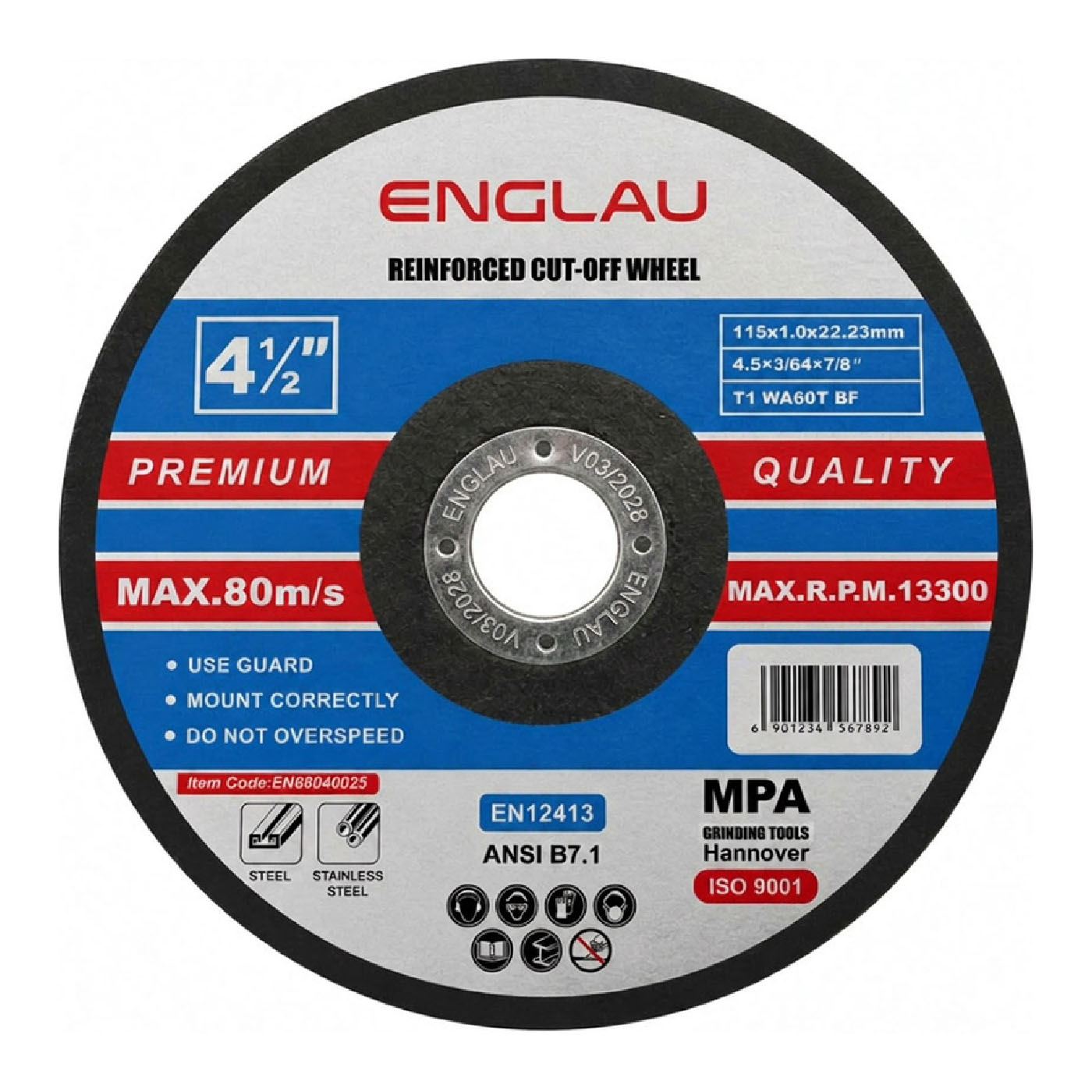
With over 20 years of expertise in the abrasives industry, Englau Group designs, manufactures, and exports a comprehensive range of high-performance abrasive solutions — including bonded cutting and grinding wheels, flap discs, and coated sanding belts. Serving the exacting demands of metalworking, structural fabrication, automotive manufacturing, and precision engineering, all our products are manufactured in strict accordance with the German EN 12413 standard — a globally recognized benchmark for abrasive tool safety and performance. Our application engineering team partners with industrial customers to optimize grain formulations, define precise product specifications, and deliver ongoing technical support that drives operational efficiency and extends tool service life.
1. Abrasive Grain Type
At Englau Group, we regard grain selection as the single most consequential decision in abrasive tool specification. After two decades of working directly with industrial customers across metalworking, fabrication, and precision engineering, we have seen how the right grain choice transforms productivity and reduces total cost of operation. Our industrial abrasive range is built around four primary grain types, each developed and tested for distinct applications and workpiece materials.
Aluminum oxide is one of the most widely used abrasive grains in industrial manufacturing, valued for its versatility and cost-efficiency. Its controlled friability causes the grain to micro-fracture during operation, continuously exposing fresh cutting edges and maintaining a consistently sharp cutting surface. While aluminum oxide offers excellent performance across a broad range of ferrous metals and wood-based materials, it has a shorter service life compared to premium grain types and is best suited to general-purpose grinding and finishing applications.
Silicon carbide is a harder, sharper-grained material with a fast, consistent cut rate, making it the preferred choice for finishing operations on low-tensile-strength materials such as cast iron, ductile iron, and non-ferrous metals, including aluminum, copper, bronze, and titanium. Its higher friability produces a clean, precise cutting action with minimal heat generation, though it is less suited to high-pressure grinding of tough ferrous alloys.
- Zirconia alumina is a dense, high-performance grain engineered for aggressive stock removal on ferrous metals and high-tensile alloys. Its self-sharpening micro-fracturing behavior sustains cutting efficiency under high grinding pressures, delivering a favorable balance of performance and tool life. Zirconia alumina is particularly effective when used with high-torque angle grinders in heavy fabrication and structural steel applications.
- Ceramic alumina represents the highest performance tier in the Englau Group's abrasive grain portfolio. Engineered through advanced sintering processes, ceramic grains deliver exceptional hardness, controlled friability, and outstanding thermal resistance. The result is the longest service life of any abrasive grain type, making ceramic alumina the most cost-effective solution for demanding applications involving hardened steels, superalloys, and other difficult-to-machine materials, despite its higher initial cost.
- For lighter-duty applications, garnet is well-suited to hand sanding and fine surface smoothing, particularly in woodworking, while emery remains a traditional choice for metal polishing and surface conditioning.
2. Grit Size
Once the appropriate grain type has been identified, grit size selection determines the balance between material removal rate and surface finish quality. Grit size refers to the number of abrasive grains per unit area of the tool surface — a lower grit number indicates a coarser grain structure, while a higher number indicates a finer grain.
Coarse grits (P10 to P40) are suited to aggressive stock removal, rapid cutting, and weld dressing operations where surface finish is a secondary consideration. Medium grits (P60 to P120) offer a balance between material removal and surface quality, making them suitable for blending, deburring, and intermediate finishing. Fine and very fine grits (P150 to P1200) are used in precision finishing, polishing, and surface conditioning applications where tight Ra surface roughness values must be achieved. Selecting the correct grit progression — moving systematically from coarser to finer grits — minimizes total processing time and ensures the final surface finish meets specification.
3. Wheel Geometry
In our experience, wheel geometry is one of the most frequently overlooked specification parameters. The geometry of the wheel determines not only the contact area between tool and workpiece, but also the clearance available on the machine, the direction of grinding forces, and the accessibility of the abrasive face in confined or complex workpiece environments. Matching wheel geometry to both the machine configuration and the operation is essential for safe, efficient performance.
Straight wheels are the most widely used geometry in industrial grinding, with the abrasive face on the wheel's outer diameter. They are suited to cylindrical, surface, and centerless grinding operations across a broad range of machine types. Recessed wheels share the same peripheral grinding face as straight wheels but incorporate a recessed center hub to accommodate specific machine spindle or flange assemblies, providing greater clearance in confined grinding environments. Cylinder, cup, and dish wheels present their cutting faces on the side of the wheel rather than the periphery, making them well-suited to surface grinding, tool sharpening, and face grinding operations that require a flat contact area. Mounted wheels are smaller-diameter tools available in a range of profiles — including plugs, cones, and points — designed for use with die grinders and high-speed spindles in precision internal grinding, deburring, and finishing of complex geometries.
4. Coating Density
Coating density is a specification parameter that Englau Group’s application engineers assess carefully for every customer application. It refers to the proportion of the backing surface covered by abrasive grain, and has a direct and measurable influence on the tool’s resistance to loading — the accumulation of swarf and workpiece material between grains that progressively reduces cutting efficiency and increases heat generation at the workpiece interface.
Closed-coat abrasives feature grains distributed uniformly across the full backing surface with no gaps. This maximizes the number of active cutting points per unit area, delivering high material removal rates and consistent surface finish. Closed-coat construction is the standard specification for metalworking applications, including weld removal, metal grinding, and surface preparation on ferrous substrates.
Open-coat abrasives cover only 50 to 70 percent of the backing surface, leaving deliberate spacing between grains. This open structure resists loading by providing channels through which removed material can escape, making open-coat abrasives the preferred choice for softer, more ductile materials such as wood, plastics, and non-ferrous metals, where grain loading would otherwise be a limiting factor.
Semi-open or semi-closed coat abrasives offer an intermediate grain density, typically reducing coverage by approximately 30 percent compared to a full closed coat. This construction balances cutting efficiency with loading resistance, making it suitable for applications involving composite materials or mixed-material workpieces.
5. Bond Hardness Grade
Bond hardness grade is one of the most technically nuanced parameters in bonded abrasive specification, and one where Englau Group’s engineering expertise adds significant value for industrial customers. The grade defines the strength with which the bond matrix retains abrasive grains during operation, and is designated on a scale from A (softest) to Z (hardest). It directly influences wheel speed capability, permissible depth of cut, feed rate, and overall grinding behavior across different machine-workpiece combinations.
As a general principle, harder-grade wheels are specified for softer workpiece materials, where the bond must resist the lower grinding forces to prevent premature grain release. Conversely, softer-grade wheels are used on harder workpiece materials, allowing grains to be released from the bond as they dull and replaced by fresh, sharp grains — a self-dressing mechanism that maintains consistent cutting performance. Incorrect grade selection results in either rapid wheel wear and high consumable costs or wheel glazing and reduced cutting efficiency. Englau Group's application engineering team provides expert guidance on selecting bond hardness grades for specific machine and workpiece combinations.
6. Backing Material
The backing material forms the structural foundation of every coated abrasive product in the Englau Group range. Its selection determines the product’s suitability for specific operating conditions — including the magnitude of applied pressure, the degree of conformability required to follow workpiece contours, and whether the application involves wet or dry operation. Englau Group offers coated abrasives across four primary backing types, each engineered to meet distinct industrial requirements.
- Cloth backings — available in cotton, polyester, and polyester-cotton blends — offer superior tensile strength and flexibility, making them the standard choice for demanding industrial applications such as belt grinding, flap disc construction, and high-pressure surface finishing. Polyester cloth is fully waterproof, making it well-suited to wet grinding and maritime maintenance applications.
- Paper backings are lighter and more economical than cloth, providing consistent cutting performance in precision finishing, polishing, and hand sanding operations. Paper weight grades range from lightweight A-weight for fine finishing to heavy E-weight for machine sanding applications. Paper backings can be treated with latex or resin to improve flexibility and moisture resistance for specific applications in woodworking, metal polishing, and plastics finishing.
- Foam and sponge backings provide the three-dimensional conformability required for hand sanding of curved surfaces, contoured profiles, moldings, and veneers. Their compressible structure allows the abrasive to maintain consistent contact pressure across irregular geometries, producing a uniform finish on complex workpiece surfaces.
- Polyester film backings offer exceptional dimensional stability, uniform thickness, and water resistance, making them the preferred substrate for precision and micro-finishing applications. The flat, consistent surface of film-backed abrasives produces highly uniform scratch patterns and tight Ra surface roughness values, meeting the stringent finish requirements of optical, electronic, and high-precision engineering components.
Frequently Asked Questions
What is the difference between coated, non-woven, and bonded abrasives?
Coated abrasives have grains bonded to a flexible backing, such as paper or cloth. Non-woven abrasives embed grit within a three-dimensional nylon fiber structure for added flexibility and conformability. Bonded abrasives are solid tools, such as grinding wheels and cut-off discs, with grains consolidated into a rigid substrate.
What materials can Englau Group abrasives be used on?
Our full range of abrasive solutions is formulated for use on steel, stainless steel, aluminum, cast iron, titanium alloys, plastics, composites, coatings, and painted surfaces.
What grit sizes are available?
Our coated and nonwoven abrasive products are available in a wide range of grades and grit sizes to meet specific application requirements. Typical grit sizes offered include P36 to P1200 for coated abrasives and medium to ultra-fine grades for nonwoven materials, covering most common needs from heavy stock removal to fine finishing. For specialized applications or the full range of available sizes, please contact us for our complete product specification sheet.
Are your products certified to international standards?
Yes. All Englau Group abrasive products are manufactured in strict accordance with the German EN 12413 standard, one of the most stringent quality certifications in the global abrasives industry. This standard governs safety and performance requirements for bonded abrasive tools, guaranteeing structural strength, operational safety, and uniform quality across our product range.
Can I request product samples or technical datasheets?
Yes. We welcome sample requests and can provide detailed technical datasheets for all product categories. Please contact our team directly with your product requirements, and we will respond within 3–5 business days.
Does Englau Group offer application-specific or custom formulations?
Yes. With over 20 years of experience, we develop market-specific, application-optimized formulations tailored to customers’ unique usage conditions and performance requirements.
Do you accept OEM orders and private label manufacturing?
Yes. Englau Group supports full OEM manufacturing and can produce our complete range of abrasive products under your brand, with custom labeling, packaging design, and product specifications customized to your market requirements. The minimum order quantity is 1,000 pieces per item.
For technical inquiries, product specifications, sample requests, or OEM discussions, please contact Englau Group directly:
Mr. Eric Lau
President, Englau Group Co., Limited
Room 1205, 12/F, 130-132 Des Voeux Road Central, Hong Kong
Phone: +86 137 7034 5768
Email: eric.twintrade@gmail.com